

Yesterday, Axios reporter Madison Mills reported that major U.S. banks have detected AI agents attempting to “take actions that appear to be independent of user instructions.” In other words, the bots are making money moves in people’s bank accounts without the owners directing them to.
“Bank executives described the situation as horrifying, with one official saying the industry has grave concerns about agents gaining access to customer accounts and taking steps that could impact user finances,” Mills reported.
Some banks, including Bank of America, Citi, and JP Morgan, are limiting third-party agents from accessing their platforms as a result and preparing “day after” scenarios that would “allow them to quickly secure or restore customer access” should the worst happen.
On Thursday, there was also a flood of stories about a security flaw in PHP, a programming language used to create an estimated 70% of websites, that could have allowed hackers to access sensitive records and payment information around the world. Researchers at Calif, a U.S.-based cybersecurity company using OpenAI’s GPT-5.6 Sol model, discovered the bug, and cybersecurity professionals have been rushing to update websites before the vulnerability is weaponized.
In light of these stories, it seems obvious that we are entering a new phase of the AI era, one in which it is exceedingly likely bad actors can and will find ways to exploit the financial system and get at our money from ever more angles. So how can we try to protect ourselves?
One obvious way: Don’t give commercially available agents, like Meta’s Muse or OpenAI’s Dots, access to your personal and financial info. Much of the unauthorized activity noted in Mills’ report came after account holders initially gave the agents permission to access their accounts. At least until banks work out the bugs—which they are actively trying to do now—it seems prudent not to hand out your banking info willy-nilly. Two-factor authentication and password managers can also help, although the Dallas Federal Reserve makes the case for storing financial passwords offline in secure locations.
Something else to keep in mind: If you give an agent permission to use your credit card for certain tasks (like shopping on Facebook Marketplace or booking a plane ticket), you likely can’t get any of your money back if it overspends or exceeds the restrictions you initially put into place. You authorized it, after all. So be careful what you ask it to do.
There are plenty of other ways AI can be used to scam you. Deepfake videos, fake personas of people you know and love and celebrities alike, and voice cloning are all common, according to Schwab, as are hyper-personalized phishing scams and automated account takeover attempts. A newer scam is called “prompt injection.” Bad actors can hide certain instructions in a webpage or email, and the AI agent may be tricked into revealing personal info or taking actions that you never intended it to.
It’s important to understand how each scam works so you can look for the red flags. With something like a fake persona or voice cloning, a sense of urgency remains one of the biggest tells that someone is trying to scam you, according to the FBI. It is unlikely a police officer or banking employee will ever reach out and need you to do something ASAP. If they are rushing to get something done, it’s likely not being done in good faith.
But in the case of the PHP flaw, hackers could potentially gain access to your financial accounts through your favorite websites, with no need for deepfakes at all. And AI is helping scammers spoof phone numbers and websites to make themselves look legit, even paying search engines to have their fake websites be listed before legitimate sites, reports Elizabeth O’Brien in Barron’s.
One strategy O’Brien suggests: Spread out your assets so they’re held at a couple “too big to fail” banks, plus a regional branch. That way, you can build a personal connection with your local bank in case you need help in a crisis IRL, and you won’t lose everything if you lose access to one of your accounts. (You should also spread out your money anyway if you exceed the FDIC savings limit.) Keep paper records of your most recent account balances, and try to keep enough cash on hand in case you can’t access your bank or credit accounts, even temporarily.
Ultimately, though, there’s only so much we as individuals can do. It will be up to the financial institutions to ensure their clients’ accounts and funds remain secure.
-Alicia
What else we’re reading (and watching and listening to)
- I saw You Can See Everything, and it left me with A LOT of thoughts and feelings, particularly about its portrayal of journalism. I’m still unpacking all of that, but for anyone who saw the film and is interested in learning more about that New York Times quote Holmes and her partner take issue with, the reporter of the profile, Amy Chozick, goes into the details and context here. Anyway…I’ll be seeing the film again on Monday! -Alicia
- Do you ever read the poems in The New York Times? I don’t usually, but for some reason Freddy and I got sucked in this week and had a lovely 10 minutes before school reading and discussing “I Dwell in Possibility” by Emily Dickinson. I think it’s because I love that first line very much. -Lindsey
- We’re nearing the end of the year, so don’t forget to use up your FSA funds if you have them! -Alicia
- I’m delighted my favorite baseball player, Payton Tolle, is going to be a special correspondent for the World Series this year. This little Instagram video compilation sums up why I think he’s such a delight. We need more public figures who are having fun, openly loving their work, and giving everyone hugs! -Lindsey
The Purse classifieds
- Not sure where to turn for financial advice? Lenet Rivas, CFP®, can help with problems of all sizes, from planning for the future to rolling over your old 401(k). Click here to learn more about Blue Otter Financial Planning, a female-founded, flat-fee financial planning company and schedule your one-on-one session with Lenet.
The Purse is now offering classified ads in our Friday newsletter! Email classifieds@thepurse.co for more info.
On our radar
- I moderated a panel on the great wealth transfer at Money20/20 in Las Vegas this past weekend. I’m still thinking about the woman who asked how to talk about estate planning when your parents or other family members may live in another country or were raised in another country and the cultural expectations around death and money are so different. More to come on that for sure—it’s clear we’re just at the beginning of having these really important conversations. -Alicia
- Friend of The Purse Lauren Smith Brody is looking to interview people for Provoked who have set aside estrangements for the sake of caregiving. For instance, a daughter who stopped speaking to her dad after he cheated on her mom but is now taking him to his weekly chemo. Quotes can be anonymous if needed! Contact Lauren at lauren@thefifthtrimester.com. I think this is such an interesting topic, and I thought you wonderful Purse readers might know someone who fits the bill! -Lindsey
Comment of the week
“Working on building up a stable of babysitters for nights out has been so good for our marriage. I know it takes effort and it revolves a bit as folks go to college or move away. Many of my friends never go out as a couple and while I rationally know why (a night out plus a babysitter is so expensive!), it seems like a big change from my childhood. I think my parents went out every single weekend either to the theater, or with friends. We can’t do that financially but I never ever regret time out with my husband.”
-Lucy D on “Home Economics No. 63: Married, 37, and living in a $1.8 million house in the Bay Area on a $540k joint income”
TikTok of the week
What else we published on The Purse this week
For paid subscribers: a great Home Ec featuring a breadwinning mom in San Francisco.
 Lindsey Stanberry

Do you have any year-end financial goals?
 Lindsey Stanberry
For paid subscribers: It’s the second installment in Lindsey’s Financial Clarity Challenge!
 Lindsey Stanberry
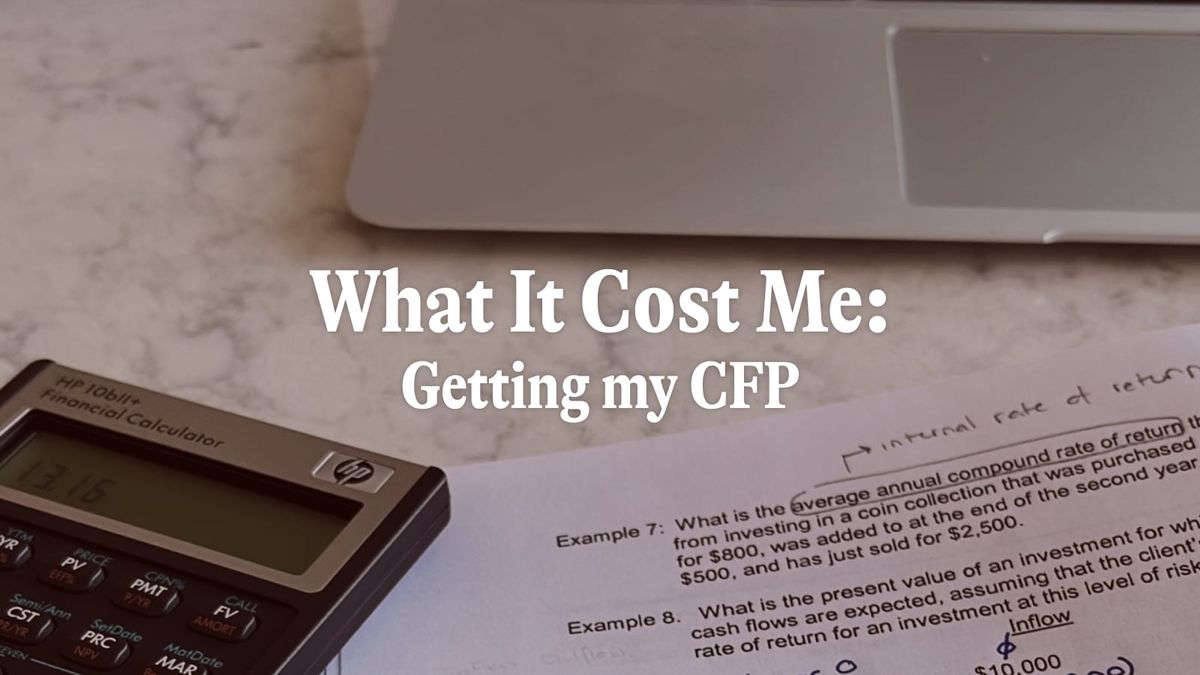
Lindsey detailed how much she spent getting her CFP.
 Alicia Adamczyk
Best money we spent this week
- We’re prepping for a small-ish birthday party for Chris tonight, which should be super fun! We spent ~$200 on snacks and food. Chris wants to cook for everyone, and I’m in charge of the dip. -Alicia
- One of my goals for this fall is to invest more time and money into my personal health and wellness. I’m not getting any younger! On Tuesday, I spent an hour with a physical therapist to discuss a plan to address some of ongoing neck and shoulder pain. I’m hoping I can be as disciplined about following his exercise plan as I was about studying for the CFP exam! ($97) -Lindsey


