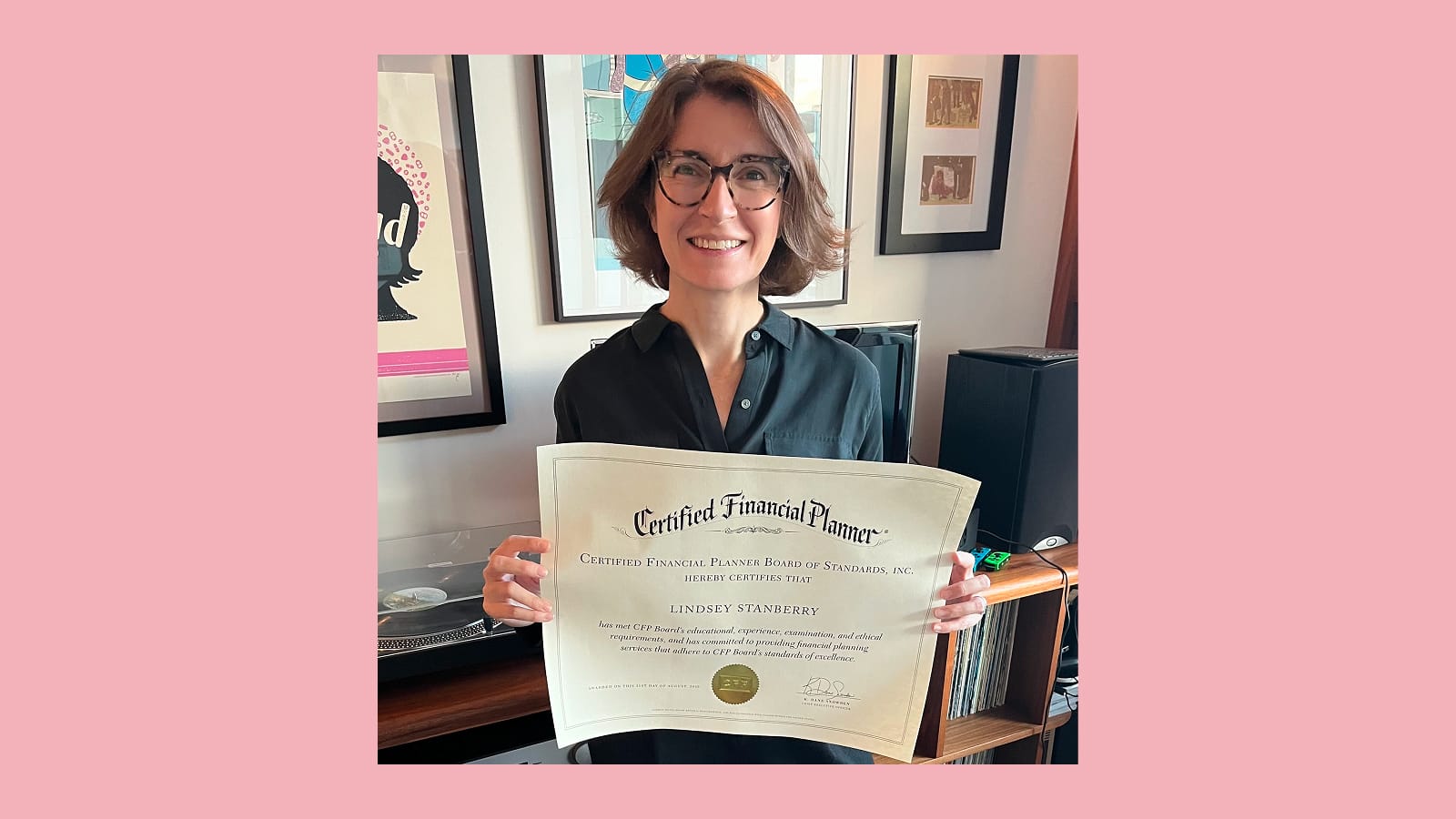
Over the past three years, I’ve watched with great admiration as Lindsey decided to pursue her CFP, squeezing in evening classes, studying at seemingly all hours, and, this past July, sitting for the six-hour exam. She was so nervous about not passing, but I never had any doubt she would. When you work with someone for ~six years, you get to know what they are capable of, and Lindsey can handle a lot.
Readers of The Purse will know we take the financial advice we give around here seriously. That’s by virtue of our journalism backgrounds and because we want this to be a fun but substantive place to discuss money. Now that we have a financial ~professional~ at the helm, we feel even more confident about what we are producing.
Of course, a lot happened over Lindsey’s three-year continuing education process. We thought it would be fun for her to detail how much it cost to add those three letters to the end of her name—and tally up the time and mental toll, too. This one is for those of you who might be wondering about whether a CFP is right for you, or those who just want to know what fee almost made Lindsey break down in tears.
Check out our other editions of What It Cost Me:
 Lindsey Stanberry
 Joy Archer
Why did you decide to pursue your CFP?
I’ve talked about this before, but when I worked at Refinery29 and wrote the Money Diaries book, I got a lot of feedback that I couldn’t be tapped as an expert source because I didn’t have any “real” financial credentials, as in I never worked on Wall Street and I was not a financial planner or accountant. I was just a journalist. That was right before TikTok exploded and anyone who made a viral video was considered an expert. (At least for a brief minute.)
It wasn’t until I went to work at CNBC that I started seriously considering pursuing the credentials. There were a few journalists on staff who were CFPs, and I even helped one of my direct reports (hi, Emmie!) get some of her education expenses covered by employer benefits when she decided to enroll in New York University’s CFP program. But then I talked to a few people who were CFPs, and they sort of discouraged me. One told me I was too creative and the education would be too boring. She wasn’t totally wrong!
The fall after I left Fortune, I did a 100-day entrepreneurial journalism program at the City University of New York, and I really enjoyed being back in school. It allowed me to sort of dip my toes into the continuing education pool and see how it would fit into my life and schedule. I definitely had a lot more flexibility since I wasn’t working a full-time corporate job. If I was ever going to do it, now was the time.
Becoming a CFP checked two boxes for me: It gives me credentials that set me apart from others in the personal finance content space, and it confirms that I am an expert to the wider world (and in my own mind!).
This is totally silly, but my mom, dad, and brother all have graduate degrees, and I always felt a little left out. Granted, I still don’t have a master’s, but at least I had to prove my skills by passing a six-hour exam, and now I can add three letters to the end of my name.
How did you choose what program to enroll in?
I wanted to do an in-person program, and New York University is the only school in New York City that offers the classes required to become a certified financial planner. I really hate spending hours on Zoom, and I was worried that I wouldn’t be disciplined about paying attention if I took online courses.
Unfortunately, only two of the seven courses ended up being in person, so I did spend so many hours on Zoom. And I am bad at paying attention! I’m a little ashamed to admit that I spent a lot of the class time half taking notes, half doing the New York Times crossword puzzles. I found I could work on the crossword without totally tuning out what the professor was saying.
NYU actually offers two CFP programs: a certificate in financial planning and a master’s in financial planning. The master’s is significantly more expensive, and you have to apply. (And maybe even submit GRE scores?) I went the certificate route.
I wouldn’t recommend the NYU program. They rely heavily on materials from Dalton Education, an educational platform that powers many of the big CFP education programs. My CFP friend wasn’t wrong about it being boring! In most of my classes, the professor would spend the whole time walking us through a slideshow, and most didn’t seem to care about engaging with their students. I love to nerd out about personal finance, so I was bummed that there was so little opportunity for class discussion.
The two classes I took in person were much more interesting because the professors were not quite as tied to the syllabus, and we could have more free-ranging conversations about financial planning, economics, the state of the world, etc.
What was your schedule/time commitment like throughout the program?
The NYU certificate program requires you to take seven classes, which I took over three years. The sessions are all about 10 weeks long and involve a three-hour class each week. Six of the classes require you to take a three-hour midterm and three-hour final, and usually the professor requires some other type of assignment that counts toward your grade. The worst was the insurance class that required a group project. I’m too old for group projects!
Outside of class, I spent at least a couple hours each week either studying, reading the text book, or completing assignments. I’d estimate it was probably 60 hours of work per course when you factor in classroom time and exam prep.
Once you finish the coursework, you have to take a six-hour multiple choice exam. The CFP Board offers the exam three times a year—March, July, and November. I didn’t want to lose momentum, so after I finished the coursework in May, I decided to take the exam in July. And studying for that was intense.
A lot of people recommended Brett Danko’s CFP test prep program, so I signed up for the in-person program in June in Boston. (The program wasn’t offered in New York.) I spent three and a half days in a conference room at a Hilton in Needham with roughly 200 other wannabe CFPs. It was awful for many reasons that I’m not ready to get into here. I’ll just say that I think sexism runs pretty deep in this industry, and it comes through in the educational materials.
I followed Danko’s program pretty closely, and in June, I was studying for at least three hours every day, giving myself just one day off a week. The last week before the exam, I studied about six to eight hours a day. It was exhausting! All in, I think I probably spent 500 hours prepping for the exam over roughly 16 weeks. Thank goodness I passed! I was so burnt out after!
So in total, I guess I spent close to 1,000 hours over three years to get my CFP? That’s a lot of time!
A few people have asked how I fulfilled the CFP Board’s experience requirement. In order to become a CFP, you have to complete 6,000 hours of professional experience. Thankfully, the work I’ve been doing as a personal finance journalist and editor for the past 10 years counts toward those experience hours. I’m grateful for the journalist CFPs who came before me who made me aware of this pathway.
How much was tuition? Other costs associated with the class?
NYU offers a 10% discount if you declare that you're a CFP candidate. It’s kind of silly because “declaring candidacy” doesn’t really mean anything. But hey, a discount is a discount!
Each class is around $1,000. And then you had to buy the books through Dalton, which was about $300 a course.
The Danko program was $2,305, plus the cost of traveling to Boston. I was able to stay with some family friends in Cambridge, so I avoided the additional cost of a hotel room, which probably saved me $800.
The CFP exam costs $825, and it was an additional $968 to get my CFP certification in the end. Not gonna lie: I nearly cried when I saw that last expense. I figured there would be a fee for the certification, but I wasn’t expecting it to be so high. But at that point, what was I going to do? I couldn’t not pay it.
How did you pay for the class? Did this strain your budget at all?
I paid course by course, so the NYU program was broken into seven payments over three years. For the test prep, I put it on my Chase business credit card and enrolled in the Pay Over Time program, which is a little like having an interest-free loan. I’m paying $256 a month over nine months. I could have paid it all at once, but I decided to take advantage of breaking up the payments.
I considered this continuing education to be a business expense, and so I’ve been paying for it with money I earn at The Purse.
While I didn’t need any financial support for the program, there are several scholarships available both through NYU and the CFP Board. If you’re interested in pursuing a CFP, but you don’t feel like you can afford it, I would highly recommend looking into scholarship opportunities.
Are there things you didn’t do because you were enrolled in the CFP program?
It’s always hard to know what the opportunity costs are. I sometimes wonder if I would have decided to return to a full-time corporate job if I hadn’t been pursuing my CFP. Attending classes and studying consumed a lot of my free time, and it was helpful that I had a flexible schedule.
It did require a lot of sacrifices in my personal life and sometimes in my professional life. Spending one evening a week in class over the course of three years meant I had to say no to so many fun evening plans. It sucks to be stuck in class while your mom friend group chat is blowing up about meeting up for drinks.
There were at least two vacations where I had to spend part of the trip studying. And I spent a lot of weekends studying when Ken and Freddy were off doing fun things without me. The lowest point was this past 4th of July weekend, when they went to Cape Cod with my parents and I stayed home to study for the exam.
How did you balance working full time on The Purse, being a mom, and taking your CFP classes/studying for the exam?
Ugh, I didn’t! Balance is such a joke! I haven’t exercised consistently in three years!
Throughout much of the program, I often felt like I was failing at one or all the areas of my life. But honestly, I feel like that even now that I’m on the other side, haha. There’s always too much to do! Someone or something always seems to be neglected.
One of the hardest stretches was the spring of 2025. I was working a full-time job at CNBC covering an editor’s maternity leave at the same time I was also running The Purse and taking the investing course at NYU. Hands down, investing was the hardest course for me. Statistics are a bear! It was so much math. And I really disliked the professor. I look back at that time, and it’s a miracle I didn’t completely give up on both pursuing my CFP and working on The Purse. I credit Ken for encouraging me not to quit.
This spring and early summer when I was studying for the exam, I had to take on a whole other level of commitment and focus. Basically, everything else went on the back burner. It was not fun, but I’m proud of myself for being so disciplined. And I’m really grateful for Ken, my mom, Freddy, and you (Alicia) for picking up the slack. You all were such an essential support system, and I couldn’t have done it without you.
Are there ongoing costs associated with the certification?
There’s an annual certification fee I have to pay to renew my credentials each year, and I have to complete 30 hours of continuing education every two years.
Now that you’re on the other side of the program, are you happy you pursued it? Do you feel it’s a good value?
I’m incredibly proud of myself. It was so much work! And the exam was so hard! I’ve joked with people that it was harder than childbirth. And you know, every joke is a little bit true.
I haven’t priced out other continuing education programs, so I can’t compare to what else is out there, but in general, I feel that pursuing a CFP is pretty affordable. If you look at the total (~$10,000), it seems like a lot, but broken up into essentially eight payments over three years makes it much more reasonable.
I wish the educational component was stronger. I really do love to learn—and I love to talk about money—but some of the CFP courses were so boring. I’d be curious to hear the experience of others who did their courses at a different university. My professors at NYU were mostly white men in their 60s, but my classmates were primarily women in their 30s and 40s who were looking for a career change. It didn’t feel like NYU invested much in the program. There were basically zero additional career development opportunities and no alumni network. I guess you get what you pay for? I think the master’s program might be more rigorous, but again, it’s much more expensive, and it’s not necessary to have a graduate degree to be a CFP.
Was it worth the actual and mental/emotional cost?
Yes, I think so.
In the three years since I left Fortune, time and again I’ve taken on hard things that a past version of myself wouldn’t have thought I was capable of. I never considered myself as someone who’s particularly self-motivated. I always thought I needed a boss and a paycheck to encourage me to do things. I was never one to have a side hustle or passion project before.
Launching The Purse and studying to become a CFP required a lot of discipline and sacrifice, and the payoff hasn’t necessarily been financial. (At least not yet!) It’s so cringe to say this, but I’m really inspired by myself, LOL. Every day I show up and I do the work. Some days are definitely more successful than others, and it never really gets easier or less scary.
It’s no small thing that I was able to get my CFP while also launching and running The Purse and being a mom and a wife. I look at that accomplishment and think, “OK, what’s the next big, hard thing? Let’s go!” And I hope other mid-career women who might feel adrift or unhappy with their jobs find similar inspiration in my story. (Is that cringe, too?) We can do anything we put our minds to! You just have to be willing to put in the time and the sacrifice. For me, personally, it was worth it.
Please comment with kindness!
Also published this week
 Lindsey Stanberry
 Lindsey Stanberry
 Lindsey Stanberry