

It’s been a big couple of weeks for Rep. Alexandria Ocasio-Cortez. The New York Democrat has been making headlines for everything from misrepresented comments about “woke 1” to rumblings about her presidential ambitions.
She also began publicly sharing her egg-freezing journey, posting videos of her daily injections and answering questions about the process on her Instagram.
Naturally, this has led to a flood of “takes” on AOC’s fertility journey—and it creeps me out to even write that sentence. She made her decision public, so she knew she’d be scrutinized. Pretty much every woman is used to hearing opinions from everyone—from their colleagues to a random bank teller—on when, how, and whether she has children. But the fervor with which those who disagree with AOC politically are going after her for sharing her experience with the increasingly common family planning measure has been hard to watch.
Despite AOC’s call to viewers to not “be weird about this,” plenty of people are being, well, weird. I won’t link to the most enraging commentary out there, but Tressie McMillan Cottom’s piece on the political messaging behind AOC’s choice is worthwhile, as is Amanda Litman on the optics.
I’ll leave it to them to hash out the politics of it all—I’d like to talk about the finances of the decision. AOC is emphasizing the financial toll of the process, stating that she waited until age 36 to get started, in part, because it is so cost-prohibitive.
“I spent years saving to get the financial breathing room that allowed me to make this choice,” she wrote on an Instagram Story. “Congress’ financial disclosures are public, so you can see for yourself that I am not rich… I could not afford this when I first wanted to do it, so I am doing it now.”
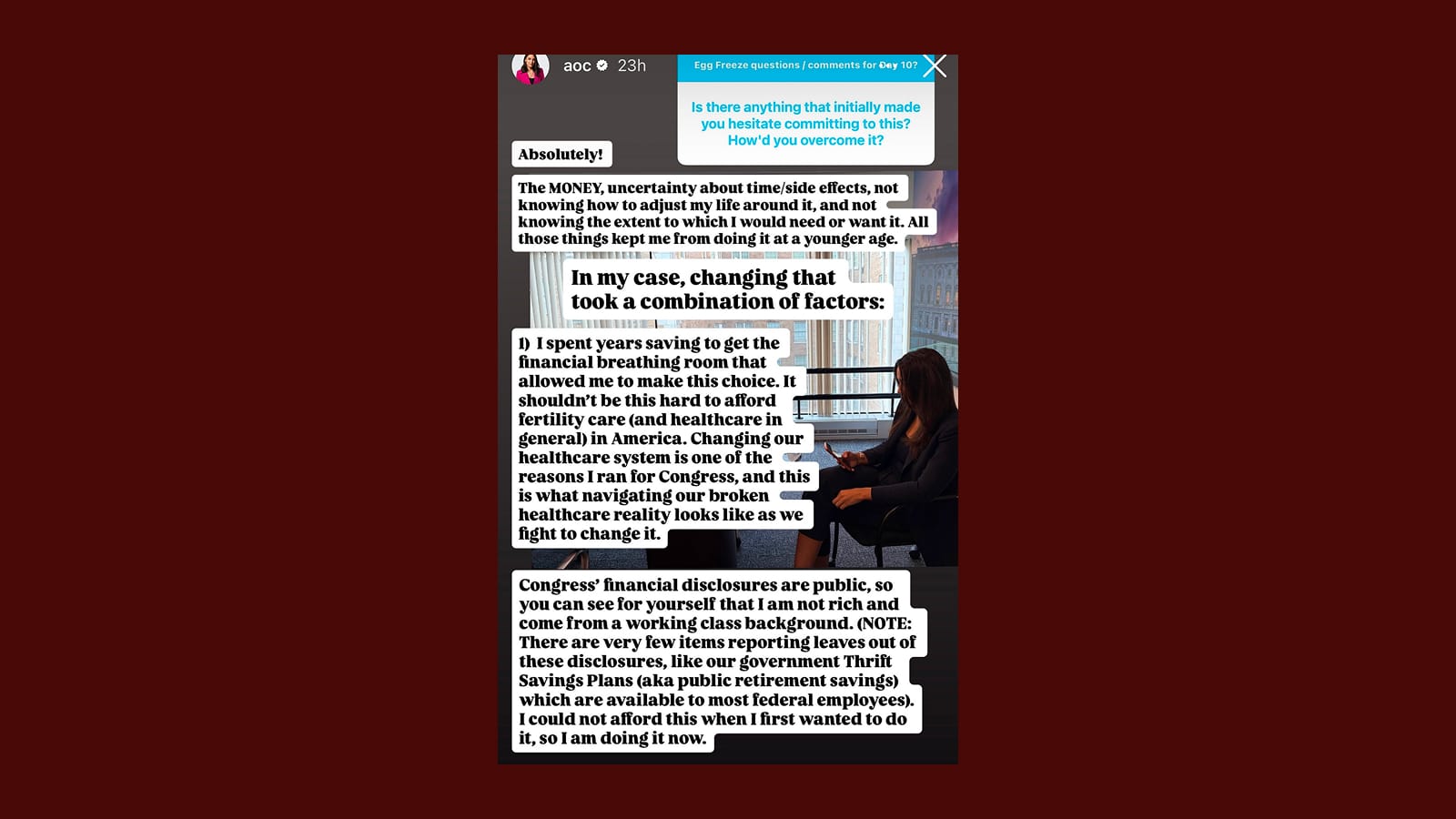
The congresswoman estimates the cost of freezing her eggs to be around $8,000 to $9,000 out of pocket, since it is not covered by her health insurance plan. That’s actually on the low end: In the U.S., a single egg freezing cycle costs around $16,000, on average, according to FertilityIQ, though it varies widely depending on location. Many women go through multiple cycles to increase their odds of fertility later. Storage and implantation have additional costs.
One reason the procedure is so expensive for many is that it is usually not covered by insurance unless you have an infertility diagnosis. But many women like AOC and Rep. Sara Jacobs, a California Democrat who froze her eggs last year, are doing it proactively. In which case, it’s considered an elective medical procedure.
Dr. Christy Lane, co-CEO and cofounder of FLORA Fertility, has studied fertility costs and access for years. She says for those who ultimately undergo fertility treatment, it can be a major life expense on par with paying for college or buying a home. Unlike those two expenses, though, women rarely plan ahead for it, financially or emotionally.
In that regard, AOC has done the right thing: She planned proactively so she has more options later. Still, the hefty price tag shows why it’s a struggle even for someone earning a $173,000 Congressional salary to afford.
 Alicia Adamczyk
If egg freezing seems like it could be the right step for you, Dr. Lane advises first finding out what your employer covers, if anything. “While some larger companies provide fertility benefits, coverage is still the exception,” she says. “Even when benefits are available, they often come with a lifetime dollar cap, a limited number of cycles, or restrictions on which clinics and pharmacies you can use.”
Some considerations:
- If your employer does offer coverage, you’ll have to do more homework. Some things to consider: Can you only use specific clinics, laboratories, pharmacies, etc.? Is prior authorization required?
- Compare clinics and ask for a complete and itemized estimate, instead of relying on the advertised price or initial treatment quote. That number can often exclude many additional costs that are billed separately. “Ask for a written estimate that includes diagnostic tests, medications, monitoring, anesthesia, laboratory services, genetic testing, embryo transfers, and annual storage, which will give you a clearer picture of the true total cost,” says Dr. Lane. Beware of “premium” services.
- Compare medication prices separately, as these may vary across specialty pharmacies. “Ask the clinic for a complete medication list, get quotes from more than one pharmacy, and ask whether any manufacturer or generic drug savings programs are available,” she says.
- Ask whether a less expensive treatment is medically appropriate. “Women should always push for reasoning first,” she says. Why is a particular treatment being recommended? What alternatives could be medically appropriate? How do the expected success rates and total costs compare?
- Consider additional costs. For egg freezing, you may also need to pay for medications, annual storage, additional cycles, etc. “If you decide to use the eggs later, you will still need IVF to fertilize the eggs, create embryos, and complete an embryo transfer,” she says.
As AOC films her daily injections and answers constituent questions about the process, she is also advocating for better insurance coverage, better medical research, and more comprehensive reproductive care in general. While reproductive rights in the U.S. have taken hit after hit, and a growing chorus of anti-choice politicos tell women their place is at home with kids—all while objecting to IVF and egg freezing—AOC’s highly public journey is a testament to the millions of women who don’t follow that script.
Rebutting Allie Beth Stuckey, the popular conservative commentator who said she is “glamorizing the lie that women can have it all,” AOC responded thusly:
“Maybe in life you can’t have everything, but here’s the secret: You can have a hell of a lot,” she said in one of her vlogs. “I am very grateful for my life. I go after what I want, but maybe that’s what they don’t like either. Too bad for them.”
Fertility planning in the news
- Ultimately, this is a story about agency and female autonomy. “To see a woman in some of the highest echelons of power model what it looks like to proactively go after whatever it is she wants—to leave as many doors open as possible, to claim agency in her future—is so moving,” Litman writes.
- Conservative male commentators like Matt Walsh unsurprisingly have a lot to say about AOC’s choice. Walsh called later-in-life pregnancies “backwards and ridiculous.” I don’t recall him having similar things to say about 42-year-old Vice President JD Vance welcoming a new baby this summer. (We didn’t want to link out to that nonsense. You can google it.)
- “Ocasio-Cortez expects her egg-freezing journey to be tangled in the discourse now—the same gendered stigma that swirls around far less famous women of childbearing age in far more average careers,” writes Michelle Ruiz for Vanity Fair.
- Between 2014 and 2021, the number of people freezing their eggs quadrupled, according to UCLA Health. People do it for all kinds of reasons, including to help with potential infertility issues later on.
- The 19th has a good breakdown of the costs, process, and other details associated with the procedure.
- Of course, freezing your eggs doesn’t guarantee you will be able to get pregnant in the future; it is highly dependent on the age you undergo the procedure.
- Friend of The Purse Ruthie Ackerman has written extensively about the cost of her fertility journey, culminating in her memoir, The Mother Code.
- In my Yahoo story about DINK spending, someone I featured revealed she and her husband had already spent over $5,000 on fertility treatments for the year, which was their out-of-pocket max before her employer benefits kicked in. She also spent $1,000 on supplements recommended by her fertility doctor.
What else we’re reading (and watching and listening to) this week
- This is a really interesting deep dive from Planet Money about how AI is affecting the music industry and the ongoing legal fight over copyright. “At first glance, this looks like another fight over technology and copyright. But the more I reported on it, the more it looked like something bigger: a test case for how an entire economy might change when artificial intelligence uses human-generated content to compete with humans doing the creating.” -Alicia
- I sent my friend Issy this article about the writer Paul Theroux's 30-mile walk along the recently opened King Charles III England Coast Path with a note, “We should do this!” I’ve never done a walking trip like that before, but it looks amazing. I’m partially inspired by Claire Zulkey, who had an amazing solo Swedish adventure this summer and summited a mountain. Here’s to the moms taking cool trips by themselves! -Lindsey
- Some potentially good news? Some state lawmakers are trying to ban ghost job listings, which may account for as much as 20% of advertised roles! -Alicia
- We’ve mostly been watching baseball lately, but on the rare evenings when there’s no game (or there was an afternoon game), we’ve gotten hooked on Ride or Die on Prime. Can I be Hannah Waddingham when I grow up? -Lindsey
On our radar
- Speaking of babies, it’s been fun to watch our friends at Babylist partner with Alex Cooper for the #BabylistItForward campaign. Cooper and Babylist announced Monday they were teaming up to buy gifts off of 1,000 baby registries, and in the week since, other influencers have jumped in to participate.
- Last chance to vote for SXSW panels! Would you vote for my panel with Realtor.com on the topic of adult children moving back home with their parents? Thank you! -Lindsey
Comment of the week
“I use one of my savings accounts as an escrow account for items that only happen once or twice a year, like car insurance or yearly software subscriptions. Each month, I pay into this ‘escrow’ account the equivalent of a monthly payment for each item so that I have the money set aside when the bill arrives (I don’t have anything on autopay). I find eliminating big swings in my checking account balance makes going off budget much more noticeable.”
-Jessica Ruzzicone on “How do you budget?”
What else we published on The Purse this week
Join a great convo about how other Purse readers are budgeting! It seems Monarch and You Need a Budget are the big winners among those who use budgeting software.
 Alicia Adamczyk
For paid subscribers: a really fun meal plan with a ton of inspiration.
 Alicia Adamczyk
Best money we spent this week
- I was in Maine most of the week and didn’t spend much money outside of some food and drinks. It was a needed reset! -Alicia
- On the other hand, I’m in Cape Cod this week on our family vacation, and I’ve been spending all the money. At least we didn’t have to pay for flights and accommodations! -Lindsey


