

A big thank-you to Chase for sponsoring this newsletter!
Scams are a frequent topic of conversation in my family group chat. My mom, brother, and I are always trading articles about the latest scams, whether it’s fake missed delivery alerts, impersonators pretending to be bank employees, or too-good-to-be-true job offers.
I like to think that spreading awareness will help protect my family from falling victim to a scam, but I also realize that bad actors are getting more sophisticated all the time. The reality is, any one of us can be vulnerable.
“Scams can happen to anyone, regardless of age,” says Nicole Sanchez, head of financial health at Chase. “There’s a common misconception that being younger or more tech-savvy means you’ll automatically recognize a scam, but fraudsters are constantly evolving their tactics. Whether that’s through text messages, social media, an online marketplace, or fake job opportunities, scammers are finding new ways to make their schemes look legitimate.”
There is strong data that reinforces why awareness is important at every age, Sanchez notes. The FBI’s 2025 Internet Crime Report shows that consumers in their 20s lost more than $560 million to internet crime in 2025, with phishing and spoofing, online buying and selling scams, and investment scams among the most commonly reported.
It’s important to know which scams to look out for and the steps you can take to help protect yourself and your loved ones. That’s why The Purse has teamed up with Chase to create this guide to help you recognize and avoid scams.
We’re publishing this guide during Chase Fraud and Scam Prevention Month in November. The goal is to share simple, practical steps people can take to help avoid scams while shopping, traveling, and giving back this holiday season. Throughout the month, Chase is hosting free educational workshops in all lower 48 states and Washington D.C. to help consumers protect their money and personal information from scammers.
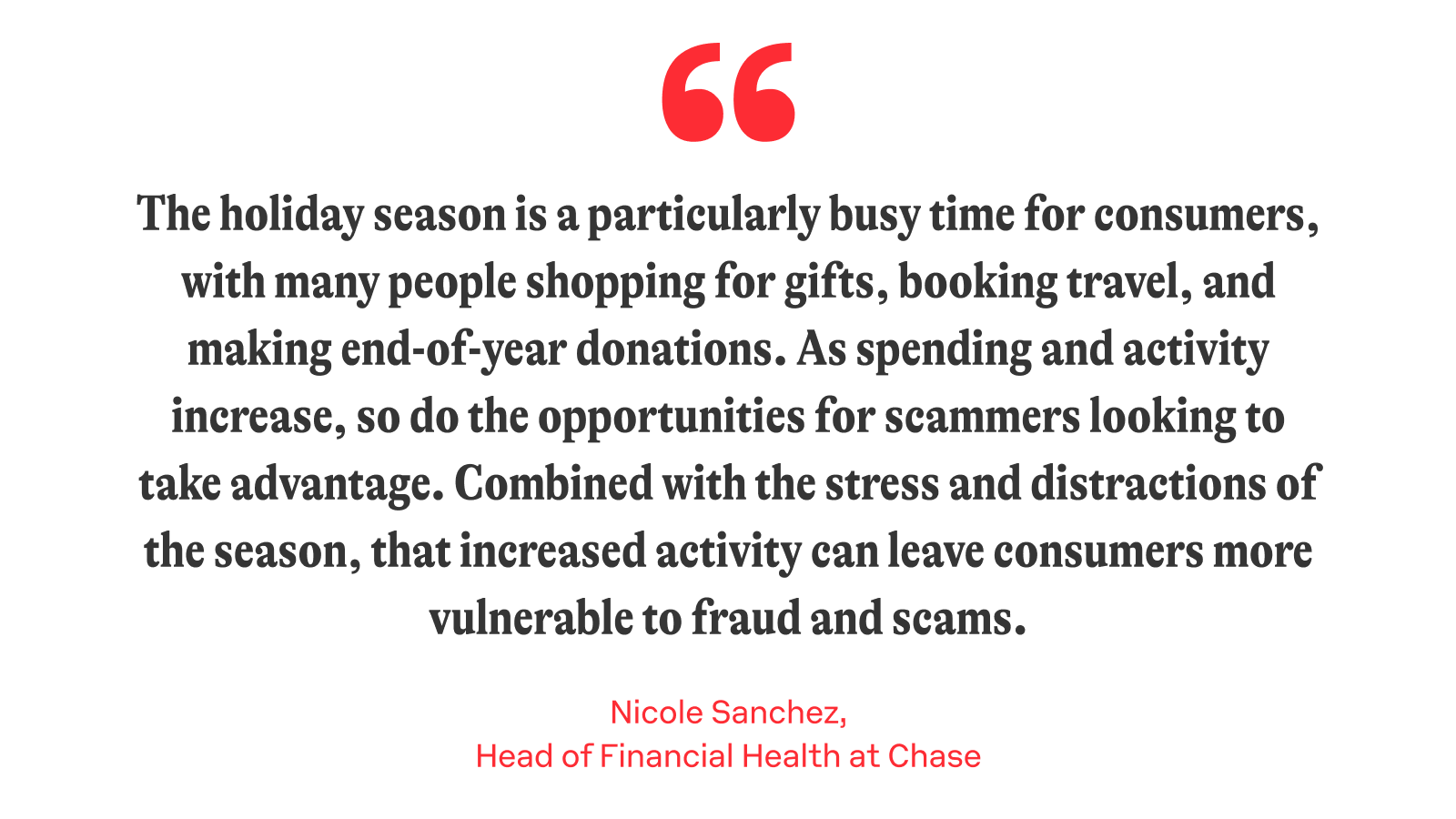
“The holiday season is a particularly busy time for consumers, with many people shopping for gifts, booking travel, and making end-of-year donations,” Sanchez says. “As spending and activity increase, so do the opportunities for scammers looking to take advantage. Combined with the stress and distractions of the season, that increased activity can leave consumers more vulnerable to fraud and scams.”
So how do we protect ourselves? We all need to slow down.
“When you’re busy or in a rush, it can be easier to miss a red flag,” says Sanchez. “Before clicking a link, making a payment, or responding to an unexpected message, take a moment to pause and make sure it’s legitimate. And when in doubt, trust your gut. If something doesn’t feel right, it’s worth taking a step back and verifying it first.”
Ahead, we’ll walk you through some of the most common scams that affect consumers during the holidays (and year-round), so you can get to know the red flags. And we’ve got some simple tips to help you protect yourself.
Check out the Chase Security Center for a suite of tools to help protect you and your loved ones.
Get smart about the scams out there
Knowledge is power, especially when it comes to thwarting scammers. Here are some of the common scams that Chase is warning consumers to watch out for this holiday season.
Travel scams:
With airfare up 23% since last Christmas, you’re probably hoping to score some deals when you book your flights and accommodations this year. But tread carefully. There are travel scams everywhere, including phony rentals, spoofed booking sites, and fake airline customer service numbers.
As you or your loved ones book travel this holiday season, make sure to double-check the URL and look for typos or extra characters. You always want it to begin with “https://” because that means the browser and server have a secure, encrypted connection, which is crucial when you’re sharing financial information online. Note: This doesn’t necessarily mean the website is legitimate.
When reserving flights or hotel rooms, try to book directly through the hotel, rental, or airline company’s official website—or your credit card company’s travel portal—and not via a random link you were served up on social media.
Even if you’re booking through a reputable platform, it’s still important to keep an eye out for scams. When reserving a rental property, look for hosts with a history of positive ratings, review the photos and listing information carefully, and be cautious of any rental that seems unusually cheap. If it seems too good to be true, it probably is!
If you choose to work with a travel agent, make sure you’ve done your research and never feel pressured to take advantage of an urgent deal.
Scammers will often ask for payment via wire transfer, peer-to-peer payment methods, or crypto because it’s both fast and almost impossible to recover. When you can, book with your credit card, which offers an additional layer of protection.
Missed package and delivery scams:
I personally have almost fallen for one of these scams before, and they are especially hard to spot during the holidays when you may have several packages on the way. A text pops up saying you missed a delivery and must take action, like clicking a link to reschedule or paying a fee, and at first glance, it can seem legitimate.
Don’t click those links! Instead, go directly to the carrier’s official website to verify the message, or contact them by phone or email using the information listed on their site. And as with most scams, don’t let them pressure you into thinking you need to take quick action or pay an extra fee.
Before clicking a link or responding to a delivery text, take a moment to check that it’s legitimate. Look for small details that seem off: a strange URL, a typo in the text, or the misspelling of the company’s name.
Be especially cautious of messages that use urgent language or pressure you to reply or take action immediately. A sense of urgency is a big red flag. Yes, you want your holiday gifts to arrive on time, but not at the expense of falling victim to a scam.
Donation scams and phony charities:
These might be some of the most upsetting scams on this list. You’re trying to support a good cause during the holidays and end up getting scammed instead.
Donation scams and phony charities can pop up on social media or even in your text messages. Scammers will share sob stories that tug at your heartstrings and pressure you into donating before you have a chance to verify where your money is really going.
Don’t let these bad actors make you cynical. Many charities rely on year-end giving and there are plenty of legitimate causes worth supporting. Just do your research before donating. Verify the organization and look into how your contribution will be used. When you’re ready to give, do so through the charity’s official website rather than a link from social media.
Online shopping scams:
Who among us hasn’t been tempted by a cool item served up to us by social media? Every day there seems to be a new brand offering a product that we can’t live without—and lucky us, it’s on super sale today!
Before purchasing from an unfamiliar retailer you discovered on social media, do your research and look for independent reviews of the store and its products.
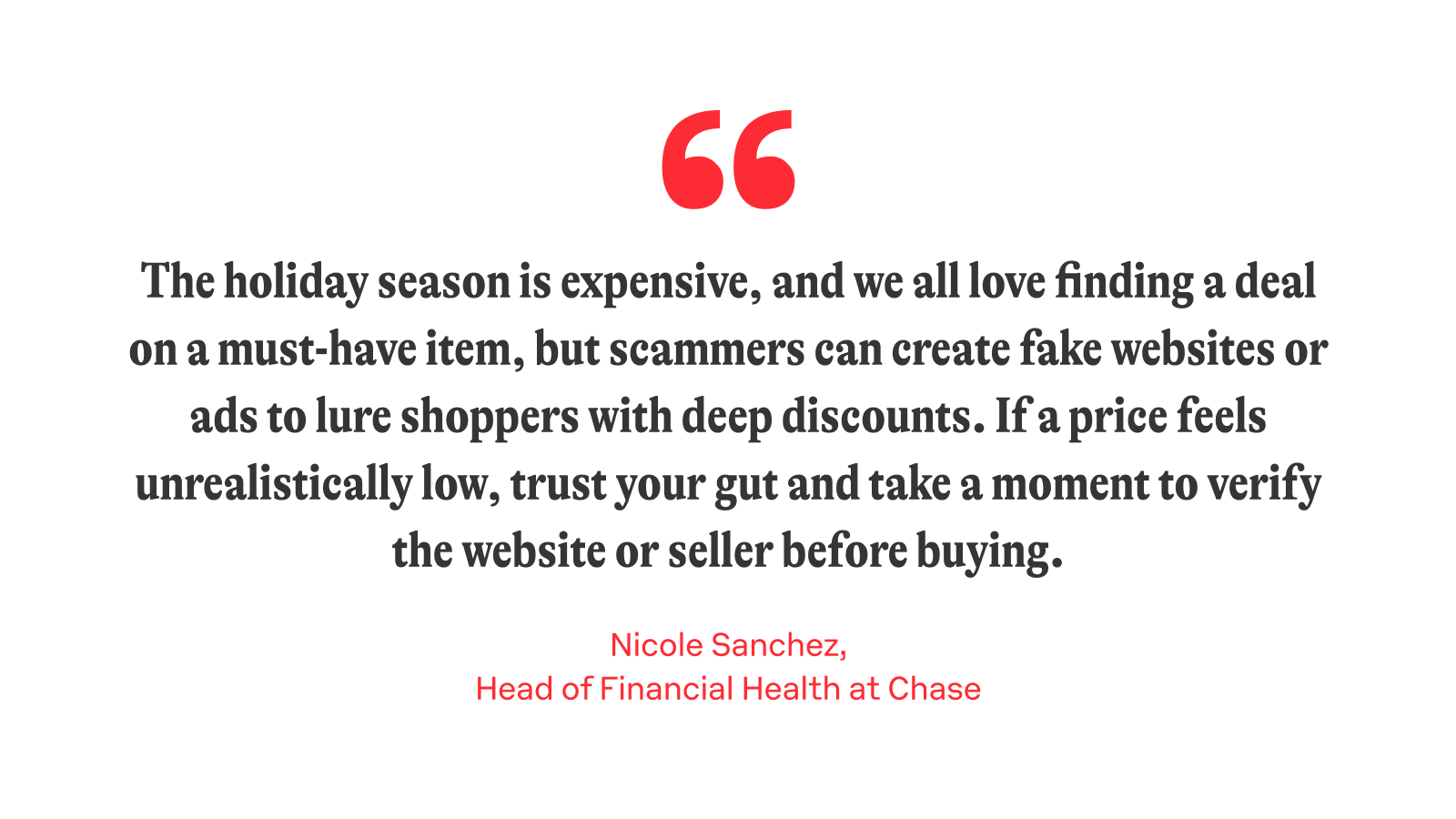
“Another red flag that’s easy to overlook is a deal that seems too good to be true,” says Sanchez. “The holiday season is expensive, and we all love finding a deal on a must-have item, but scammers can create fake websites or ads to lure shoppers with deep discounts. If a price feels unrealistically low, trust your gut and take a moment to verify the website or seller before buying.”
Yes, there are always some big sales during the holiday season, but you probably aren’t going to be able to nab the hottest gift of the year at a huge discount. And the tween in your life isn’t going to be impressed by an off-brand squishy that you found online, especially if it pops an hour after she opens it.
Similarly, watch out for gift card scams on social media. Scammers may sell gift cards at a deep discount through online marketplaces, but the cards may be tampered with or invalid. It’s safer to buy gift cards directly from trusted retailers. Be careful with your gift card information, too. If you receive a gift card and want to check the balance, only use the retailer’s official website or app. Scammers can create fake balance-checking sites to steal your gift card number and drain the funds.
The best way to approach online shopping: Make a list, start early, do your research, shop only with reputable retailers, double-check URLs, and don’t get distracted by the many offers that pop up in your social media feed.
5 simple ways to help protect yourself from scams:
1. Slow down and verify.
And watch out for urgent messages.
“One of the biggest red flags is a false sense of urgency,” says Sanchez. “Scammers often pressure you to act quickly, whether it’s claiming you’ll miss out on a deal, lose a package, or face a more serious consequence. If a message is pushing you to act right away, slow down and verify it through a trusted channel before you respond. Even taking 10 minutes to slow down and verify that an offer is legitimate before paying can make a big difference.”
Remember: Very few things in life are a true emergency—especially when it comes to shopping and planning travel around the holidays. Legitimate companies and your bank are not going to call you and pressure you to send money or provide personal information. If you receive a suspicious call, hang up and call back using the phone number you find on the official website or app.
2. Know the red flags.
- Urgent requests to send money
- Unsolicited texts, emails, or phone calls that demand action
- Requests to pay with gift cards, cryptocurrency, or peer-to-peer payments, which can be difficult to recover
- Deals that seem too good to be true
- Unexpected requests for passwords, PINs, or verification codes
3. Act quickly if you think you’ve been scammed.
- Stop communicating with the scammer.
- Document everything: the URL/website info, the scammer’s contact info if you have it, and any transactions you made or personal details you shared. You’ll want to remember as much about the incident as possible when you report it to your bank and the authorities. Take notes!
- Contact your bank to report the incident. They’ll ask you to verify recent transactions to ensure there is no fraudulent activity. In some cases, they may cancel your credit or debit card and send you a new one.
- Change your passwords on your financial accounts. Whenever available, enable extra security measures like biometrics or passkeys.
- Report the scam to your local law enforcement or state attorney general, and submit an inquiry to the FTC at ftc.gov/complaint for official documentation.
4. Proactively protect your personal information.
It’s always good practice to review your credit card and bank statements regularly (at least once a month) to make sure all the transactions are correct. Consider signing up for free credit and identity monitoring through Chase Credit Journey®, which alerts you if your personal information is exposed in a data breach or on the dark web.
5. Share your experience.
If you’ve fallen victim to a scam, share your story with others in your circle. I know it can seem awkward or even embarrassing to talk about losing money, but awareness is one of our best defenses against these bad actors. Alerting others to the latest scam tactics could help prevent your friend or family member from falling victim next.
For more information, visit Chase.
Disclaimer:
For informational/educational purposes only: Views and strategies described in this article or provided via links may not be appropriate for everyone and are not intended as specific advice/recommendation for any business. Information has been obtained from sources believed to be reliable, but JPMorgan Chase & Co. or its affiliates and/or subsidiaries do not warrant its completeness or accuracy. The material is not intended to provide legal, tax, or financial advice or to indicate the availability or suitability of any JPMorgan Chase Bank, N.A. product or service. You should carefully consider your needs and objectives before making any decisions and consult the appropriate professional(s). Outlooks and past performance are not guarantees of future results. JPMorgan Chase & Co. and its affiliates are not responsible for, and do not provide or endorse third party products, services, or other content.
Deposit and credit card products provided by JPMorgan Chase Bank, N.A. Member FDIC.
© 2026 JPMorgan Chase & Co.


