A few weeks ago, The Purse received this question from a reader (shortened for brevity’s sake):
How do people, in a truly practical way, manage their spending while staying consistently within their budget? Do people who successfully live within their means track every penny in a spreadsheet? If not, what does their system actually look like?
My finances are solid, but they’re also fairly tight. I have a spreadsheet where I enter every single purchase down to the penny. It’s effective, but it’s also tedious.
The problem is that even with a deep understanding of my finances, I don’t think I could accurately keep track of something like dining out, or really any spending category, without logging every transaction. For example, I thought I spent $1,100 on groceries this month (going off the vibes of how much fancy food I did or did not purchase), but in fact spent $1,350. For me, $250 matters.
Maybe it’s different for people without kids, but with a family, every month feels completely different. One month we have sports expenses. Another month I’m buying three new school backpacks. No matter how much I plan, there are always several unexpected expenses. When those pop up, I either:
- Dip into savings while keeping my other budget categories the same, or
- Adjust my budget categories to make room for them.
I’m not convinced that pulling from savings every time an unexpected expense comes up is the right approach, so I usually end up shifting money between categories, which means I feel like I have to track every dollar so I can adjust accordingly.
So I’m genuinely curious: How do other people do this?
We then put it to all of you in our Question of the Week, and the responses there are well worth reading—especially if you, too, are struggling to figure out how to actually make a budget that works for you.
Some respondents said they do, indeed, need to track their spending down to the penny. Others swear by apps, and judging by the comments on that post and this Note on Substack, You Need a Budget and Monarch Money are fan favorites.
The truth is, there are countless different ways to budget, and it will likely take trial and error to find what works best for you. As Lindsey and I have written before, neither of us really has a strict budget; we have a set amount that is okay to spend each month, and we stick to that. After many, many years of interviewing people about their budgets, testing out budgeting software, and reading all of the books, I find that the lo-fi approach works best for my brain and spending tendencies. I am simply never going to be able to stick to a strict spending regimen.
In fact, loosening up how you approach your budget might do wonders for your stress levels, says Rachel Lawrence, a certified financial planner and Monarch’s head of advice and planning. When I saw that so many readers seem to love Monarch, I reached out to Lawrence to see if she has any tips or other suggestions for those who can’t find their budgeting groove. And Lawrence’s advice is to embrace having an imprecise budget.
There are a select few people who are very good at (and even enjoy) sitting down and tracking every single thing they spend money on—and I suspect quite a few Purse readers will fall into that category—but most people are not going to do that. And being too stuck on hitting very specific metrics can actually do more harm than good when it comes to your money.
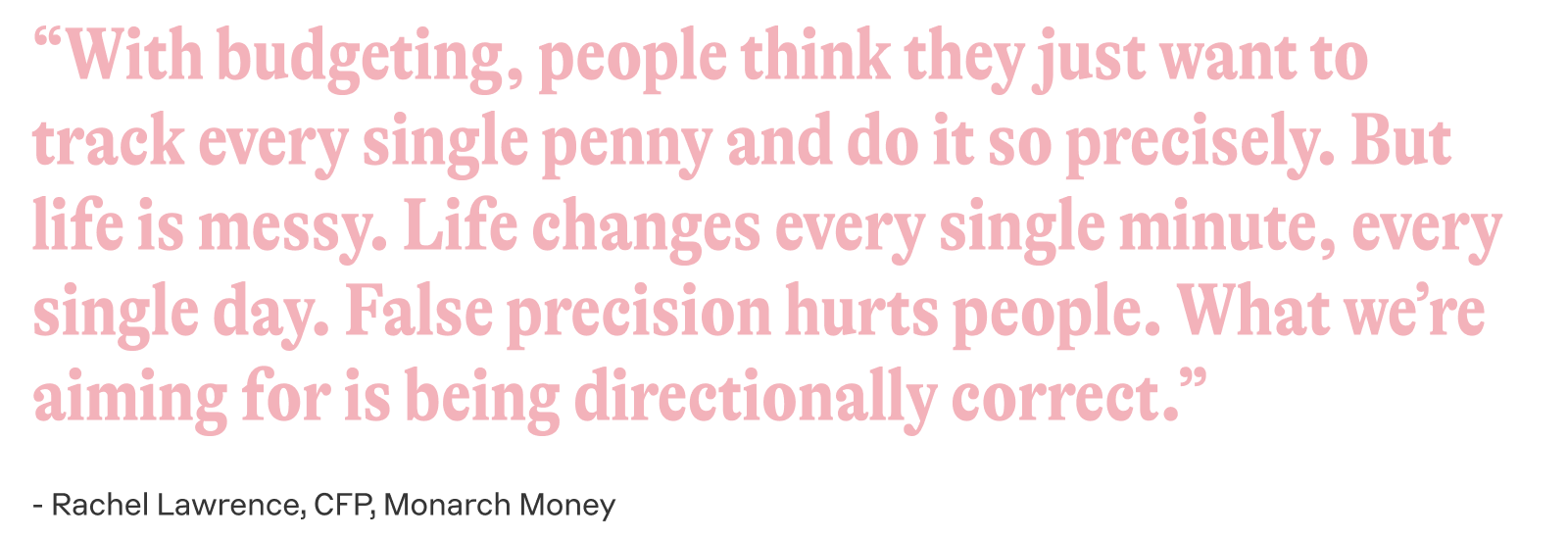
“With budgeting, there’s this temptation that because it’s numbers and math, people think they just want to track every single penny and do it so precisely,” says Lawrence. “But life is messy. Life changes every single minute, every single day. False precision hurts people. What we’re aiming for is being directionally correct.”
For those who find tracking every penny too overwhelming—or who struggle with a zero-based budget—Lawrence recommends the One Number System.
Based on the First Step Cash Management System, devised by Marty Kurtz, CFP, the One Number System involves dividing your expenses into four buckets:
- Fixed monthly expenses: This includes things like your mortgage or rent payment, car note, utilities, minimum debt payments, etc. You could cut some monthly expenses if you needed to (e.g. streaming services), but you have committed to these, and you have to pay them.
- Fixed non-monthly expenses: These are expenses that you need to pay throughout the year but not every month, like Christmas and birthday gifts, tuition, kid’s camp, travel, auto maintenance, credit card annual fees, property taxes, etc. You can also think of this bucket as a sinking fund. You can estimate how much you need for these annually and then determine a monthly fixed cost, or savings amount.
- Future expenses: Emergency fund contributions, investments, retirement savings, debt payments beyond the minimum, etc.
- Flexible (flex) expenses: Everything else, including eating out, shopping, entertainment, etc. Anything that’s changeable, meaning it’s not essential and you can trim if needed.
If you’re basing your budget on monthly income and spending, Lawrence recommends dividing your flexible spending amount by 4.3 to get a weekly number, which is the “one number” in the One Number System. That way, if you find you are overspending week to week, you can go through everything that falls into your flex category and find places to save.
“If you hone in on the flexible expenses—because those are ones we’re making decisions about every single day—you can effectively set yourself an allowance, a maximum,” says Lawrence. “Any time you’re about to go spend money on one of these flexible expenses, you just pull up the balance of your bank account and see if you have the money for it.”
For married couples, it can be helpful for each spouse to have their own flex account. It can also be helpful to have different checking accounts for fixed expenses and flex expenses, to keep them further differentiated. Choose the option that works best for you.
You can tweak the categories as you see fit; the expenses listed under each bucket above are just suggestions. The flex expenses will likely be the most variable for people. Some, for example, categorize groceries under flex expenses, since spending can be so different month to month. Lawrence, meanwhile, puts groceries under fixed.
“Flex budgeting doesn’t care the category where you spent your money—if it was shopping or eating out or restaurants or groceries—as long as you just don’t go over your total number.”
Don’t miss our September sale! Get 10% off your annual subscription!
Adding more budgeting rules
You might look at the above and think, “Great, but how do I know how much I should be spending in each of those four categories?” In that case, there are plenty of other budgeting strategies you can overlay.
One is the classic 50/30/20 budget, which was devised by Sen. Elizabeth Warren (before she was a politician) and her daughter Amelia Warren Tyagi and popularized in their 2005 New York Times bestseller, All Your Worth: The Ultimate Lifetime Money Plan. With this budget, 50% of your income goes to needs, 30% goes to wants, and 20% goes to savings/debt. Or, if you follow the One Number System rubric:
- 50% includes fixed monthly expenses and fixed non-monthly expenses
- 30% includes your flex spending
- 20% includes your future spending
In this framework, Lawrence says the most important category is the 20% savings bucket. In other words, try to only spend four-fifths of your income each month, which Lawrence suggests basing off of your net income if you make pre-paycheck contributions to your retirement account. That’s a heuristic that is helpful to many people who feel stuck trying to figure out what a good savings rate is.
Accounting for surprise expenses
The original reader asked for a way to account for unexpected or one-off expenses. In her case, it is hard to plan for all of the outlays that come with having kids, like backpacks and camp fees and all that good stuff. This is where the fixed non-monthly expense category, or sinking fund, comes in.
Lawrence advises reviewing your transactions for the past year and adding up how much you spent on the one-off surprises that inevitably crop up in life. That gives you a base figure you can divide by 12, and you can aim to save that much each month going forward. You can also try to look forward a year (or six months) to see what major events are coming up that you will need to save for, like a wedding, a vacation, or home renovations.
It might not be perfect, but it’s a start. And anything not accounted for, you can pull money from your emergency fund without guilt.
“With emergency funds, a lot of people get really caught up on the strict definition of what it should be,” says Lawrence. “If you didn’t plan for that expense, and you have no other budget categories you can pull that money from, and it is that important to you, maybe that’s an emergency fund expense. It’s a cash reserve. It’s there to help buffer you out.”
Ultimately, Lawrence advocates for more flexibility in all areas—as long as you are actually doing what needs to get done. To that end, make it as simple as possible to budget, save, and meet your goals. Set up an auto-payment from your checking account to a savings account after each paycheck to ensure that you’re putting money aside. Name your accounts to help you better visualize your goals.
As you get more comfortable with your budget, or as new expenses pop up, you can tweak your plan as needed.
What about you—how do you budget? Would a system like this work for you?
More from The Purse:
 Alicia Adamczyk
 Alicia Adamczyk
 Alicia Adamczyk