

For all the hand-wringing over whether a college degree is worth the money, parents don’t seem to be fazed.
In fact, more American parents than ever before say they plan to cover the entire cost of their kids’ college education. As such, they are saving more than ever for it, on average, according to the latest iteration of Fidelity Investments’s biennial College Savings Indicator study, which surveyed over 2,000 families nationwide with children ages 18 and younger who are expected to attend college.
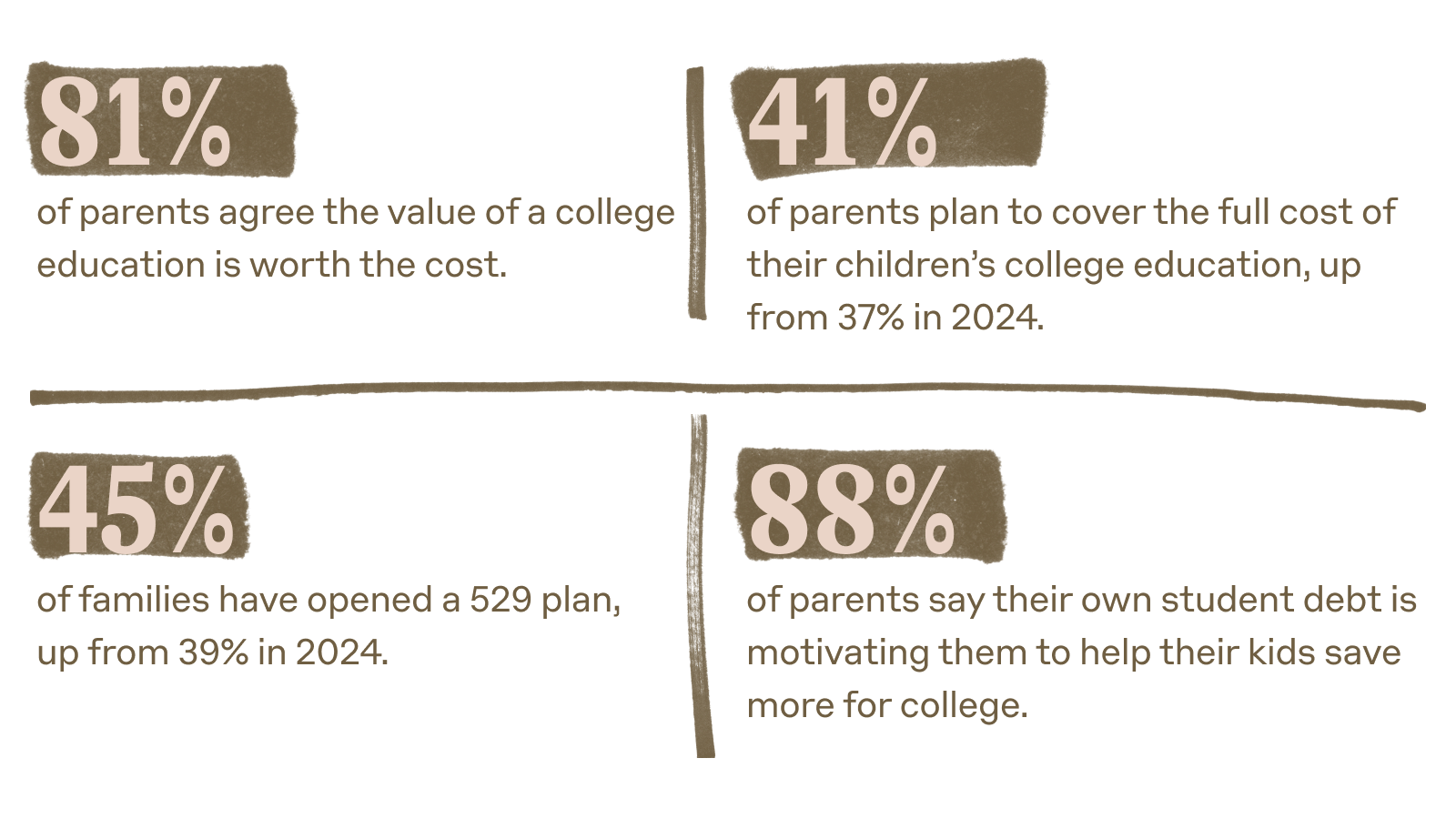
Just over 40% of parents plan to cover the full cost of their children’s college education, up from 37% two years ago. Among parents who only plan to cover a portion of the cost, that amount is 55% on average, up from 52% in 2024.
Of course, just because you plan to do something doesn’t mean you will succeed. But parents are making impressive strides when it comes to saving: A record 84% have started putting money away for their kids’ education, and 45% have opened a 529 plan to do so. That decision is likely to pay dividends.
For the uninitiated, a 529 is a state-run, tax-advantaged investment account. Parents can contribute and invest funds to help pay for college or other education expenses down the road.
Financial experts love 529s because the tax benefits are very good. Earnings on the investments are not subject to federal tax and are generally not subject to state tax when the money is spent on qualified education expenses (more on those below). And some states also offer a deduction or a tax credit on your state tax bill.
Is college worth it?
The vast majority of parents still think a college education is worth the cost, according to Fidelity’s study, and the data backs them up. The median weekly earnings of workers goes up with more educational attainment while their unemployment rate falls, according to the Bureau of Labor Statistics.
Of course, the cost of higher education never seems to stop increasing—in 2026, the average cost to attend a four-year, in-state university is $108,584, according to the Education Data Initiative—and most readers will be familiar with the scourge of student loans. That makes a 529 a very attractive savings vehicle.
And, as Cory Latham, managing director of Fidelity’s 529 college savings, points out, funds in a 529 don’t just have to be used to pay for a traditional, four-year liberal arts degree. They can pay for community college tuition, trade school tuition, an apprenticeship program—the list goes on, and the accounts get more flexible by the year.
“Have you looked at the price of a trade school? It’s not as if these things are inexpensive,” says Latham. “If your kid’s going to do something when they graduate, this is going to most likely help them out.”
529 funds can cover:
- College, graduate school, trade schools, or vocational training (including room and board and other related expenses)
- K–12 tuition (up to $20,000 in 2026)
- Homeschooling expenses
- Tutoring fees
- Student loan repayment (up to $10,000)
- Apprenticeships and continuing education
And more!
How much should you save for college
Many of the parents Fidelity surveyed said they were inspired to start saving for their kids’ college because of their own student loan debt. They don’t want their children to bear the same load that they did.
But it can be tricky to know whether to pay off more of your own loans, contribute to your child’s 529, or put your money toward other goals, like retirement.
There’s no perfect answer to this. Everyone’s financial situation—debt load, income, goals, etc.—is different. Ask yourself what your top financial priority is, says Latham. If it’s to save for your kids’ college, then that’s where the biggest chunk of your monthly (or quarterly or annual) savings should go. If it’s your own retirement, then invest more in your 401(k) or other retirement account.
Another challenge: It’s impossible to know how much college—and the college your kid in particular will go to—will cost in the future. That makes it a little more difficult to set a savings goal.

After you pay your bills each month, consider what you have leftover for savings. Latham suggests thinking about it like so: “What’s an amount that I can give on a periodic basis, like every month, every quarter, that is not going to impact me? That I can just kind of set it and forget it?”
That could be $25 a month to start, with additional contributions from one-off lump sum payments, like extra cash you receive from a work bonus or tax return.
But remember, you may have 18—or more—years to save. The amount you can contribute to a 529 when your child is a baby may be very different from the amount you can save each month when they’re 10. This is a question you can keep coming back to and keep tweaking as your child gets older and your finances change. Check in periodically and adjust as needed.
“Whatever you’re saving here, you’re not paying later. And that’s going to have the chance to grow,” says Latham. “Less of a bill is always better than more of a bill.”
Don’t forget: Family and friends can gift to a 529
A great perk of 529s is that family and friends can make contributions to them. And they’re often happy to do so, says Latham.
“The more you have people participate in it, the better it is. And people feel really good about it,” he says. “I’d much rather get that amount in a gift, than bring home another Lego set.”
Grandparents, aunts and uncles, and anyone else who wants to contribute can do so, and there are few limits on how much. Just remember: The annual gift exclusion is currently $19,000 per year ($38,000 for married couples). Anything given over that amount needs to be reported to the IRS.
Of course, it’s unlikely that a family member will be able to give your child that much for their 529, but it’s not unheard of. And 529s offer the opportunity for people to give an accelerated gift of up to $190,000 ($95,000 for single people) to a 529 account in one go (that’s five years worth of gifts at one time).
You will likely need to set up a gifting page within your 529 account, and then share that link with your loved ones. (Babylist has a new tool called Early Investor, which allows you to easily connect your 529 and share info with friends and family.) You may also want to check your 529 plan’s rules to see if there are limits on how much others can gift at a single time. Suggest your loved ones make contributions at your child’s big milestones or during holidays.
Some parents fret that they’ll invest too much in their child’s 529 and get hit with a big tax bill if they decide to use the funds for nonqualified expenses. There are some work-arounds. Up to $35,000 in the 529 can be rolled into a Roth IRA. Accounts can be transferred to other beneficiaries.
And you don’t have to save enough money to cover the entire tuition costs. Some financial experts recommend thinking about the cost of college in thirds: a third will come from your 529, a third will be paid out of pocket, and a third will be covered by financial aid. Don’t forget, an increasing number of colleges are offering free tuition to students whose families earn up to $200,000 a year.
Higher education in the U.S. is expensive, but a little planning can go a long way. For many parents, a 529 is one of the best investments they’ll ever make.
“When you hear people talking about college being worth it, maybe the typical “four year, go away from home, live in a dorm for a few years and off campus for a few years” [college experience]—isn’t for everybody, but that doesn’t mean that college and higher education isn’t,” says Latham. “It just means that you choose what path is best for you.”


