

Today’s guest author is Stefanie O’Connell, an award-winning writer, speaker, and author of the forthcoming The Ambition Penalty: How Corporate Culture Tells Women to Step Up—and Then Pushes Them Down, which hits bookstores on May 19. Here she writes about a frustratingly common trend: mothers being pushed out of the traditional workforce, and people spinning this as a feminist choice. -Alicia
Earlier this year, the job site Glassdoor released its 2026 gender pay gap report, which includes some painfully unsurprising findings: The gender pay gap doubles over the course of a career.
“The gender pay gap grows from 12% for workers with 0 years of experience to 19% for workers with 10 years of experience and 25% for workers with 30 years of experience,” the report reads.
These gaps remain far greater for Black women, who were paid 68.3% as much as white men, and for Hispanic women, who were paid 64% as much as white men in 2025, per the Economic Policy Institute.
And yet, Glassdoor’s findings were presented under the headline, “Beyond the Gap 2026: Redefining career success and compensation for women,” suggesting that women’s wage growth stalling out in their mid-to-late 30s, while men’s career trajectories continue to climb for another decade, may not be such a crisis after all.
After acknowledging that “the wage gap that widens for women in their 30s is largely structural,” the Glassdoor report goes on to rebrand this systematic failure as a personal recalibration: “The women thriving after 35 have decoupled their worth from job titles [...] These aren’t stories of women settling for less. They’re stories of women choosing differently,” the report says.
As a writer reporting on women’s ambition, I’ve seen this attempt to reframe systematic gender inequality as a “feel-good personal growth story” everywhere.
In the face of targeted federal job cuts and attacks on DEI that resulted in 300,000 Black women pushed out of their jobs, and mothers of young children experiencing record-setting drops in labor force participation, The New York Times published a piece titled “Girl Boss to No Boss” in July 2025. The piece presents a similar suggestion that women’s lack of comparable advancement and representation in the corporate world might just be a sign of women “redefining ambition” en masse.
To be fair, this rebranding of institutional inequality as personal fulfillment isn’t totally new. The trend of women seeing their incomes flatline while their male colleagues enjoy steady pay growth has long been dismissed with the familiar refrain, “Well, that’s when many women are in the thick of early motherhood.”
As an ambitious woman personally experiencing the messy days of early motherhood, I want to react to this kind of statement by screaming, “WHAT ARE YOU IMPLYING?”
The unspoken implication is that mothers don’t deserve to be paid as much as their male peers. After all, “That’s when men become fathers,” would not be tolerated as a rationale if men’s incomes were hitting a wall a decade before their female peers.
We are so ready to believe that women’s underpayment, underadvancement, and underrepresentation is a matter of their own making (or choosing) that we can’t even be bothered to acknowledge all of the data that show us exactly the opposite.
For example, in a paper studying what happens when women actively try to protect themselves against the motherhood penalty (where mothers are less likely to be hired, promoted, or paid equally), researchers Stephan Benard and Shelley Correll found that these women were still discriminated against at work.
Instead of being penalized for a perceived lack of competence or commitment (typically used to justify a mother’s lower pay), these mothers were penalized because the efforts they made to prove their commitment and competence at work meant they were likely to be perceived as “hostile” and “less likable.”
“ It's important to think about who's delivering the take,” says Raena Boston, founder of The Working Momtras, a community dedicated to supporting mothers navigating the intersection of paid labor and care. “Nine times out of 10 it is a very privileged woman.” Meaning someone who can rebrand chronic underpayment and underadvancement as the true meaning of power, because they can afford to see it that way.
“Most people need two incomes to survive if they have a family. We're not just doing this for fun,” says Boston.
I dedicated a whole chapter of my book to researching popular claims like: “Women just have naturally different ambitions,” and I know Boston is right. The data repeatedly shows that mothers do not have meaningfully different aspirations than their male counterparts. What is different is that they often do not have the same choices and support available to realize those goals. As I write in The Ambition Penalty:
It is not the same choice when a new mother must balance the vast majority of childcare demands with her career, (while her workplace sidelines her from advancement opportunities and pay), while new fathers are rewarded with greater income and career opportunities, and enabled to seize them with the greater at-home support of a spouse.
To pretend these choices are the same isn’t just dishonest, it reinforces discriminatory patterns that may not look like explicitly banning or excluding women from certain spaces, opportunities, and freedoms, but effectively function in the same ways—all the while gaslighting us with claims that our choices are the same and our only limitations are ourselves.
And so, the question I keep coming back to is this: Who does it serve to pretend that women’s lack of opportunity and support is a choice? And more than that, an empowering one?
“It leads to the hyper-normalization of all these women falling out of the workforce,” Boston told me. “Like, Oh, it’s not that bad. Here are these women in The New York Times who are making it work, and they're doing better than ever. It reinforces that in our country, the answer to systemic problems is hyper-individualism. And if you can’t figure it out, there's something wrong with you.”
In other words, the more we buy into the story that women—and especially mothers—are freely opting out of their professional ambitions, the less likely that our underpayment, underadvancement, and underempowerment will ever be treated as a true crisis.
-Stefanie O'Connell
What else we’re reading (and watching)
- I recently read Tracy Clark-Flory’s beautiful new memoir My Mother’s Daughter, in which Tracy shares the story of connecting with her half-sister through a DNA test, years after their mother’s death. Tracy’s mom was sent to a home for unwed mothers in the 1960s and coerced into putting Tracy’s sister up for adoption. It’s a (sadly) timely and stunning blend of reporting, cultural commentary, and personal storytelling. -Stefanie
- I’ve also been devouring Soraya Chemaly’s newsletter Unmanned, especially her recent piece on how men buy and read fewer than 20% of bestselling women’s fiction and nonfiction while women read men and women’s work equally (and the frightening implications of this gap). -Stefanie
- TBH, this season of Hacks hasn’t been my favorite (it feels a little too madcap?), but I did love the recent AI episode, where both women expressed many of the feelings I have about this new technology seeping into creative fields. I also recommend checking out Wired editor-in-chief Kate Drummond’s interview with Hacks co-creators (who are married?!) Paul W. Downs and Lucia Aniello, who go a bit deeper into their complete distaste of AI. (Also, this is basically a Kate Drummond fan newsletter now!) -Lindsey
- On the same topic, I thought this article on the “girlbossification of AI” was an interesting (and quick!) read. It’s not surprising to see some of the world’s most successful women leaning into automation as a way to help us “do it all,” but I was equally intrigued by the pushback they’re getting from fans. (I also really appreciated New York writer Angelina Chapin pointing out that Reese Witherspoon was also an NFT evangelist, and well, that didn’t turn out so great. -Lindsey
- I started watching Widow’s Bay on Apple TV, and it’s eerie, unsettling, and just delightful. It’s horror but also extremely funny and odd. I don’t love scary stuff generally, but the humor and characters really shine here; I can’t wait for next week! (Also the creator is the woman behind one of my all-time favorite tweets.) -Alicia
- Honestly, I could use some recs for good articles to read! What’s captured your attention lately (outside of the news of the day)? -Alicia
On our radar
- Celebrating the release of my new book The Ambition Penalty: How Corporate Culture Tells Women to Step Up — and Then Pushes Them Down, officially out on Tuesday, May 19. If you’re in (or near) NYC, come join us for this very special launch event at Barnes & Noble Upper West Side on May 21 (tickets are free, but RSVPs are required here). Alicia and Lindsey will be there! -Stefanie
- In the section above, I was going to link to this article about men not reacting well to the single women they’re dating owning homes, and then I realized Stefanie wrote it! Check it out. -Alicia
TikTok of the week
@aliciatalksmoney May 13, 2026: Does the US tax code increasingly penalize salaried professionals? #taxes #economy #career
♬ original sound - Alicia Adamczyk
Graph of the week
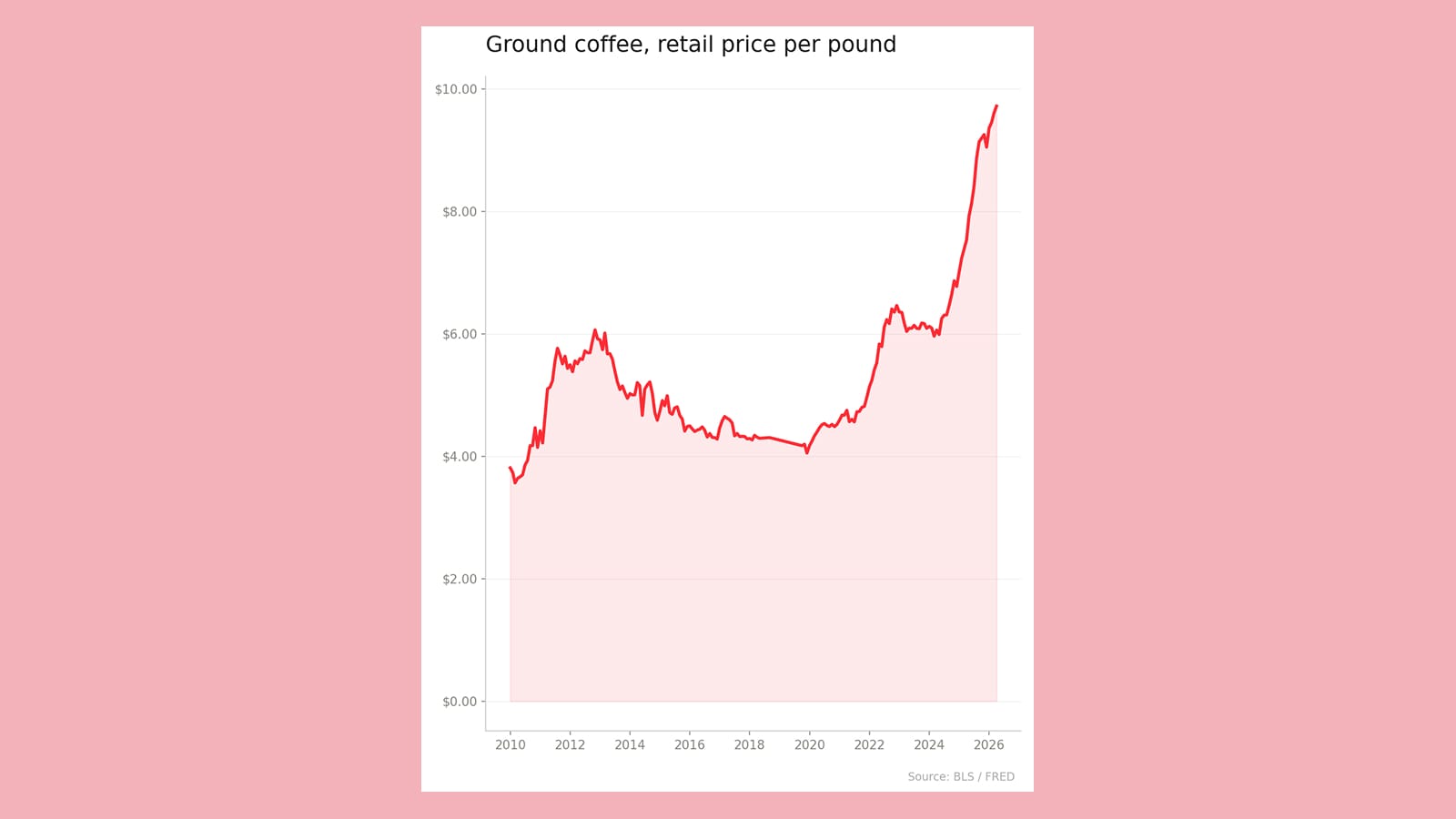
Bad news for caffeine lovers. Inflation is increasing at the highest rate in years thanks in part to tariffs and the war in Iran, and while rising gas costs have captured much of the attention, some grocery items are also seeing their prices soar.
Take coffee: The retail price for ground beans has increased almost 30% in the past year, according to federal government data.
What else we published on The Purse this week
Join the conversation!
 Lindsey Stanberry
Send this to the new grads in your life.
 Alicia Adamczyk
A must-read Home Ec (and comment section).
 Lindsey Stanberry
How much do you have saved?
 Alicia Adamczyk
Best money we spent last week
- My girlfriends from childhood are all turning 40 this year, so we’ve been having dinners every other month since the start of 2026 to celebrate (which is hard to coordinate between 11 people, most of whom have young children and do not live in the same place). But I’ve made it to every one so far, and it’s always been a good time. ($140) -Stefanie
- Chris and I are planning a short trip for our first wedding anniversary at the beginning of June (!), and I found a cute hotel situated in the Catskills, a place I’ve never really visited despite having lived in NYC for 12 years! Looking forward to some hiking, kayaking, winery visits, and general unplugging. ($685) -Alicia
- I saw Bruce Springsteen at Barclays Center last night, and no lie, I cried through most of the three-hour show. I’ve seen the Boss six times, but this might have been one of the best concerts I’ve ever seen. Who knew it would be so cathartic to scream “ICE OUT” at the top of my lungs with 19,000 of my now-dearest friends? Ken bought the tickets months ago, and they weren’t cheap, but I can say without a doubt it was worth every single penny. We’re trying to decide if we should buy tickets for Saturday at MSG. ($400) -Lindsey
This post includes affiliate links. The Purse may receive compensation if you click the link and make a purchase. It comes at no cost to you.
Like this newsletter? Forward it to a friend!


