


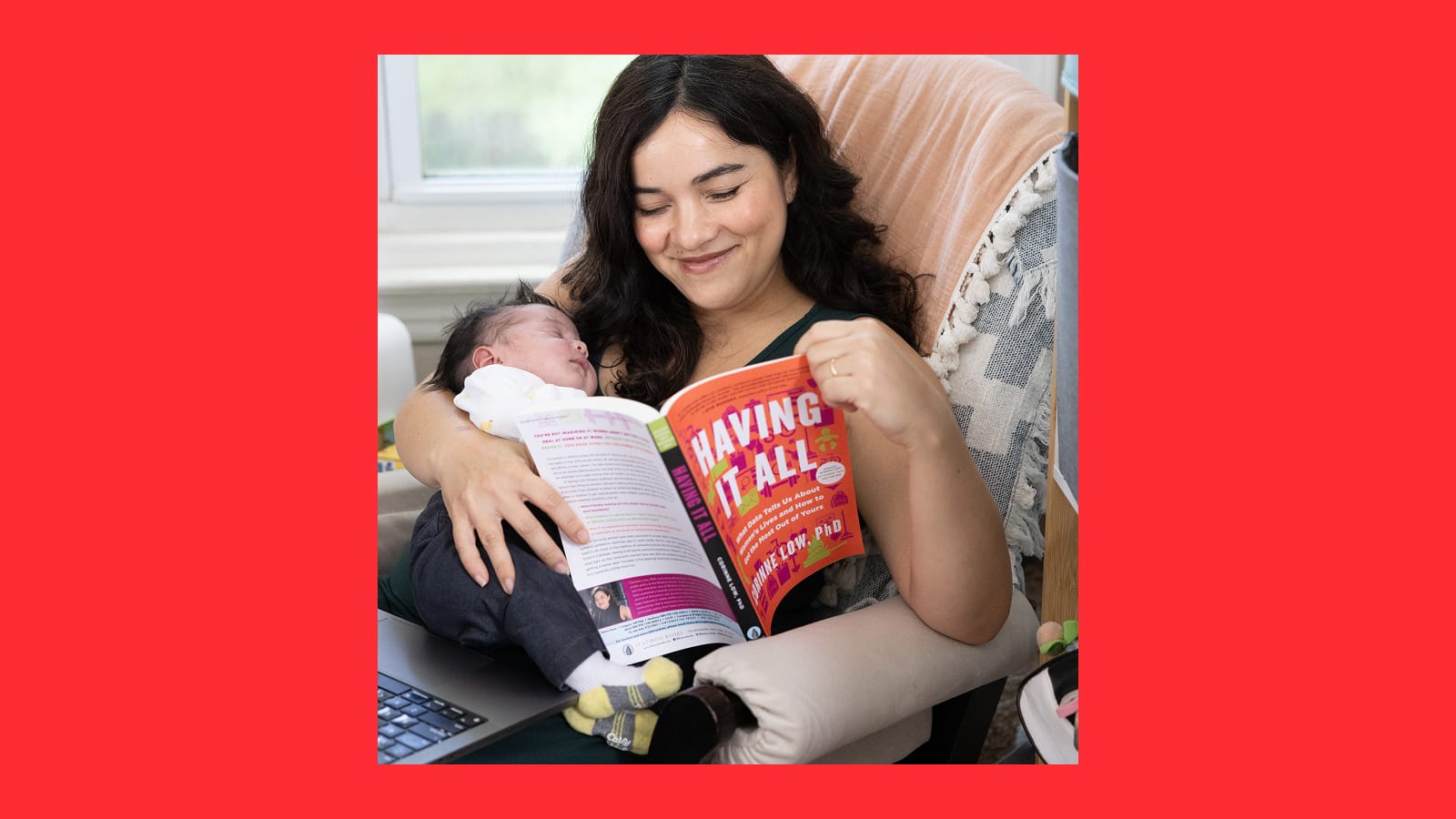
This month, Division of Labor is getting a little meta. We’re featuring Corinne Low, a professor at the Wharton School of Business, who has extensively researched and written about heterosexual household and gender dynamics. She has a new book out that aims to help couples develop a framework for “creating a better, happier life.”
In Having It All: What Data Tells Us About Women’s Lives and Getting the Most Out of Yours, Low investigates the decisions that shape women’s lives and the economic and societal constraints they face while making them. The book takes an evidence-based approach to show how gender roles have and haven’t evolved over the years. Broadly speaking, more women work outside the home, but men aren’t increasing how much work they do within the household. As Low writes, that leaves many women who are juggling work and household responsibilities feeling depleted and unhappy.
Throughout the book, Low candidly delves into how her own life supports her research, and how she’s made some big changes over the past few years. She got divorced from her first spouse, a man, and later married a woman. Her experiences have been the topic of some recent buzzy (and cheekily titled) articles, including The Cut’s “This economist crunched the numbers and stopped dating men,” and The Philadelphia Inquirer’s “Her path to ‘having it all?’ Be gay and move to Philly, a Wharton economist says.”
The book is an eye-opening investigation of how the stereotypical division of labor came to be, and how it has failed to evolve with other changing norms. For some, it may be an uncomfortably close portrayal of the gender, workplace, and household dynamics they’ve personally experienced.
Low’s goal is to help women “be as relentless in finding good deals for themselves as [they] are in trying to make everything work for everyone else all the time.” And she isn’t recommending that all women divorce their husbands. She writes about the concept of “personal utility function,” which is economist speak for the idea that we each have a set of unique ideas and ways of identifying and maximizing what gives our lives meaning.
“I want to encourage you to think like an economist as you make life decisions,” she writes. “The changes I made may be totally different from the ones you choose in your life. Your utility function is unique to you.”
Rather than putting even more expectations on women, Low redefines the tired concept of “having it all” as “finding out what you need and how to get it in a reality that too often lets women down and implores us to do more while settling for less.”
A few years ago, I was lucky enough to hear Low speak at Wharton, when I participated in a business journalism program there. Her lecture stuck with me—I wrote down her name as a good potential future source—so I was excited to see her work in the news recently and get the opportunity to feature her here in The Purse.
We’re looking for more stories for the new year! If you’re interested in sharing your Division of Labor, please fill out this form. It’s far less intensive than the Home Economics form (though we’re looking for new Home Ec contributors, too!). - Alicia
Name: Corinne Low
Age: 41
Spouse’s Name: Sondra Woodruff
Spouse’s Age: 44
Relationship Status: Married
Number of children and their ages: Two kids, an eight-year-old and a six-month-old
Your job and how many hours you work per week: I am a professor at the Wharton School of Business, an author, and a speaker. I work full time, plus.
Your spouse’s job and how many hours they work per week: Sondra works in events marketing—also full time, plus.
Type of child care you use: We have a nanny for the baby, school plus au pair for the eight-year-old. We are currently a bit over-resourced to accommodate the book tour and a launch for Sondra’s job, but we will be under-resourced when our au pair finishes in December!
How do you split up household responsibilities? We do it based on who cares more/is better at the task, which works for us since we both have things we care about and are good at. This does not work when one partner claims not to care about most household things (see my post on weaponized indifference). I do more of the cooking and meal planning; Sondra does more of the cleaning and laundry. She manages the car and soccer, and I coordinate child care for days off. She plans parties; I plan vacations.
What labor do you outsource? Lots of child care, including somewhat redundant coverage right now because I’m traveling a lot, and so sometimes we need morning or evening coverage, and we need to know that we have a backup solution if our nanny’s kids are sick or the eight-year-old needs to stay home from school. We have a cleaner who comes every other week. Our au pair does the kids’ laundry, so when she finishes in December, I’ll be finding a new solution for that.
I never used grocery delivery in Manhattan, because the grocery store was across the street. But now that grocery shopping involves getting in a car, and we only have one car that Sondra takes to work, and the baby hates the carseat, I only get groceries on Instacart. I like cooking, but for particularly busy weeks we use a meal delivery service—not a kit, because the point is not needing to cook, but pre-cooked meals you just heat up. (We use Home Appetite, which is local to Philly.)
And right now, it’s a bit loony, but either the au pair or I take the eight-year-old to soccer in an Uber, because of the aforementioned one-car issues. We also have a professional organizer who comes about once a month to organize a different area, like toys one month, fridge and freezer the next, kitchen cabinets the next. Game changer.
I have not figured out how to use a virtual assistant or a solution like that, and I do badly need help with things like expenses and keeping the house from exploding. When our au pair wraps up, we are planning to have a “mother’s helper” (Ugh, that sexist language! Household helper!) come a few days a week to do some of the things the au pair helps with, plus some basic tidying. Maybe my houseplants (which readers of my book know that I advise throwing out) will finally be watered.
The key framework I want women to have for outsourcing is that not outsourcing a task means hiring yourself to do it. Can you afford to hire yourself for everything that needs to be done? Outsourcing isn’t just for wealthy people, either. Medieval peasants ate takeout—a fact I uncovered researching my book—and very modest income families take their cars to the mechanic to get the oil changed. If we assign value to women’s time, it makes us think about outsourcing differently!
How did you decide who does what? For a while, I was a single mom who had set up my life with lots of support so I could continue pursuing my demanding career. I got help with things like laundry so I could do things like bedtime. This is a key framework in the book: spending your time on things that contribute to your utility, the economist’s word for joy and meaning.
When Sondra moved in, she was basically a bonus set of hands at first, and so the first things she took on were things that she wanted done at a higher standard than me: cleaning the car, mopping the floors, doing laundry more often, washing the tub, and sweeping the bathroom floor more often than I would. She also is more athletic than me, so she pretty quickly became the soccer mom.
Then, as our availability shifted, we needed to continuously reallocate. At one point she was laid off, so she was taking on more at home. Then we had a baby, and we needed all hands on deck in all areas. Then Sondra got a very demanding (but also fulfilling) new job at the same time as my book tour was about to kick off, and we realized we needed more help than our initial plan, and so we switched from daycare for the baby to an amazing nanny who lives in the neighborhood. She has been able to take the baby home with her on the occasional night when I’m traveling and Sondra is also working late.
We allocate tasks not just between us but also decide what to outsource based on what is meaningful and important to us. I want to see my kids as much as possible, so having a nanny has worked well, because on days when I’m not traveling, I can work from home and get some extra cuddles.

Can you share one “parenting hack” that’s worked for your family? Setting and holding the limits that you need to be OK. I always found holding the bedtime limit to be a struggle (with a then-four-year-old), until I got separated, at which point, as a single mom on the tenure track, I desperately needed that post-bedtime time to get a little work done. What I found was that when it was a necessity, I just held the boundary with a fortitude I had been lacking prior to that. It’s the difference between how we were often late for things I wanted to do on weekends, but never late for school. Somehow, my son intuited there was just a little bit of a harder boundary when I say, “We have to go” on school days versus the weekend.
What I want is for parents to give themselves permission to hold a hard limit when it’s our own needs on the other side, rather than external constraints.
How do you spend quality time together as a couple? This is where getting the kids to bed on time is key. Just before the baby was born, the older kiddo started pushing the limit on bedtime and wanted more parental attention at, like, 9 p.m. We literally had to make a schedule that showed that he got special time with one of us at 8 p.m., but that we were “off duty” by 8:30 p.m. He could read, he could listen to podcasts, but it just couldn’t involve one of us! Because that after-bedtime time is so key to the two of us. Too often these days we’re working, because we’re both in a particularly busy season, but on the nights where we get to lay on the couch with a movie on, the moment when both kids are finally asleep feels like a huge exhale.
Also, eating good food together! Prior to the six-month-old, we had weekly date nights. Then we were in the brief newborn phase where they’ll sleep in a carrier in a restaurant. Now, we’re going to arrange extra child care at least one evening a month and get back into the swing of solo date nights.
Do you feel like you have a fair division of labor? I think the goal should be a nourishing, sustainable, and evidence-based division of labor, which I think we have!
What I mean by evidence-based is that skills, preferences, and time availability—not gender roles—should determine who does what. Sustainable means no one is getting resentful or feeling like their needs are getting short-changed. Both people are getting equal leisure time just for them. Nourishing means that the whole is more than the sum of its parts—you’re each feeling grateful for the other person, because they’re doing things that you don’t want to do, taking things off your plate that you think are hard, and freeing up your time.
Car stuff stresses me the eff out. So, knowing someone else is taking my car in for an oil change or an inspection, it’s the best—it feels like love. The nice thing about a same-sex relationship is that when I’m doing stereotypically female home production, I don’t resent it. I’m able to embrace the utility I get from cooking for and feeding my family, without feeling like it has an asterisk because I’m getting stuck in a gendered role. When women carry too much of the home production, it takes all the joy out of caring for someone else. You don’t get the reward from cooking a meal or steaming a shirt with love, because you’re not getting that love-through-labor in return.
Anything else you’d like to share? In my research, I show there’s this period of life called “the squeeze” where household and work responsibilities peak at the same point in the lifecycle. When you’re in the squeeze, you can feel like you’re drowning with no way out. I just want to send some solidarity to other working parents experiencing that! (I was out of the squeeze, and then I decided to have a book baby and a human baby at the same time, and now I’m right back in it!) The data says that this period will pass. The key is how to get out of it with your sanity and your relationship intact. That might mean investing more in outsourcing than is sustainable long-term, or it might mean letting more things go and letting them be a little messy and imperfect until you’re on the other side, or it might mean saying no to more things that eat up our time (like homemade holiday meals and the houseplants!), knowing we can say yes after the squeeze passes. I’ll be here figuring it out right alongside you!
Corinne and Sondra shared a recent week day.
4:30 a.m.
Corinne: Sleeping but actually nursing the baby.
6:00 a.m.
Corinne: Probably nursing again.
6:30 a.m.
Sondra: Wake up to get ready for work.
7:30 a.m.
Sondra: Commuting.
8:00 a.m.
Corinne: Awake to nurse the baby.
Sondra: Still commuting.
8:30 a.m.
Corinne: Send older kid off to school with the au pair.
Sondra: Get to work.
9:00 a.m.
Corinne: Hang with baby until nanny arrives.
Sondra: Work.
9:30 a.m.
Corinne: Eat breakfast finally and get ready for work.
10:00 a.m.
Corinne: Work. (I sometimes bike to work.)
12:00 p.m.
Corinne: Pump.
12:30 p.m.
Corinne: Lunch, then back to work.
Sondra: Lunch, then back to work.

3:00 p.m.
Corinne: Pump.
4:30 p.m.
Corinne: Head home—sometimes get a quick workout in if there’s time.
5:00 p.m.
Corinne: Take baby from the nanny and get the older kid ready for soccer.
5:30 p.m.
Corinne: The au pair takes the older kid to soccer.
Sondra: Start commuting home.
6:00 p.m.
Corinne: Eat dinner with the baby, then hang out with the baby.
7:00 p.m.
Corinne: Still baby time.
Sondra: Pick up the older kid from soccer.
7:30 p.m.
Corinne: This is my “special time” with the older kid.
Sondra: This is my baby time.
8:00 p.m.
Corinne: Tape a podcast on Australian time.
Sondra: Get the kids ready for bed.
8:30 p.m.
Corinne: Still taping the podcast.
Sondra: Put the baby to bed, then finally have dinner.
9:30 p.m.
Corinne and Sondra: We clean up together and finally get a moment.
10:00 p.m.
Corinne and Sondra: We say we’re going to bed, but we both procrastinate for another little bit answering emails.
10:30 p.m.
Corinne: Get into bed, and I do Duolingo.
Sondra: Get into bed. I do Wordle and check Instagram.
11:30 p.m.
Corinne: We’re both asleep—oh wait, I have to nurse again.
12:00 a.m.
Corinne and Sondra: Zzzzz
Thank you so much to Corinne and Sondra for sharing your day! We highly recommend you check out Corinne’s book, Having It All, and her newsletter.
Please comment with kindness!


