


This newsletter is brought to you by our friends at Faye!
Turn on CNN, and you just might get a dose of betting odds with your daily headlines.
It was recently announced that the network is striking a partnership with Kalshi, a global prediction market company. CNN will feature Kalshi’s data during TV broadcasts, in digital content, and on social channels. That includes a real-time ticker of predictions related to the weather, culture, news, and politics. CNBC, Yahoo Finance, Sports Illustrated, and Time also have partnerships with other prediction markets.
It’s one of the latest—and in my opinion, grossest—examples of the growing financialization of our economy. Rather than producing goods and services, companies focus on financial engineering for short-term profit. We are seeing the finance sector take up a greater share of economic output, and non-financial companies make more and more money off of financial services.
“ The long-term vision is to financialize everything and create a tradable asset out of any difference in opinion,” Kalshi CEO and co-founder Tarek Mansour recently said.
Kalshi users (and anyone participating on a prediction market’s platform) essentially place bets on the outcomes of various scenarios. Recent trending bets were related to the day’s closing price for the S&P 500, whether President Donald Trump will release the Epstein files, and who will win the Stanley Cup. (The NHL also has a partnership with Kalshi.) Users bet “yes” or “no” that something will happen. For example, right now on Kalshi, you can bet on how many measles cases there will be this year. You can buy a “yes” for “above 2050” for $0.59. The outcome will be verified by the CDC on December 31, 2025, and your payout will come an hour later.
Of course, Kalshi doesn’t call these wagers “bets.” Instead, users trade “prediction contracts.” As such, Kalshi isn’t regulated like a casino, and the federal government provides little to no oversight. Given that the president’s son sits on the advisory boards of both Kalshi and Polymarket (another prediction market), it is unlikely they will be regulated anytime soon.
It’s not too hard to understand why it might be a bad idea for prediction markets—gambling by any other name—to be incorporated into every aspect of our daily lives, but particularly our political news. The U.S. is already supremely divided. Do we really want to see what happens when any one of us can monetize every difference of opinion, every conversation, every interaction?
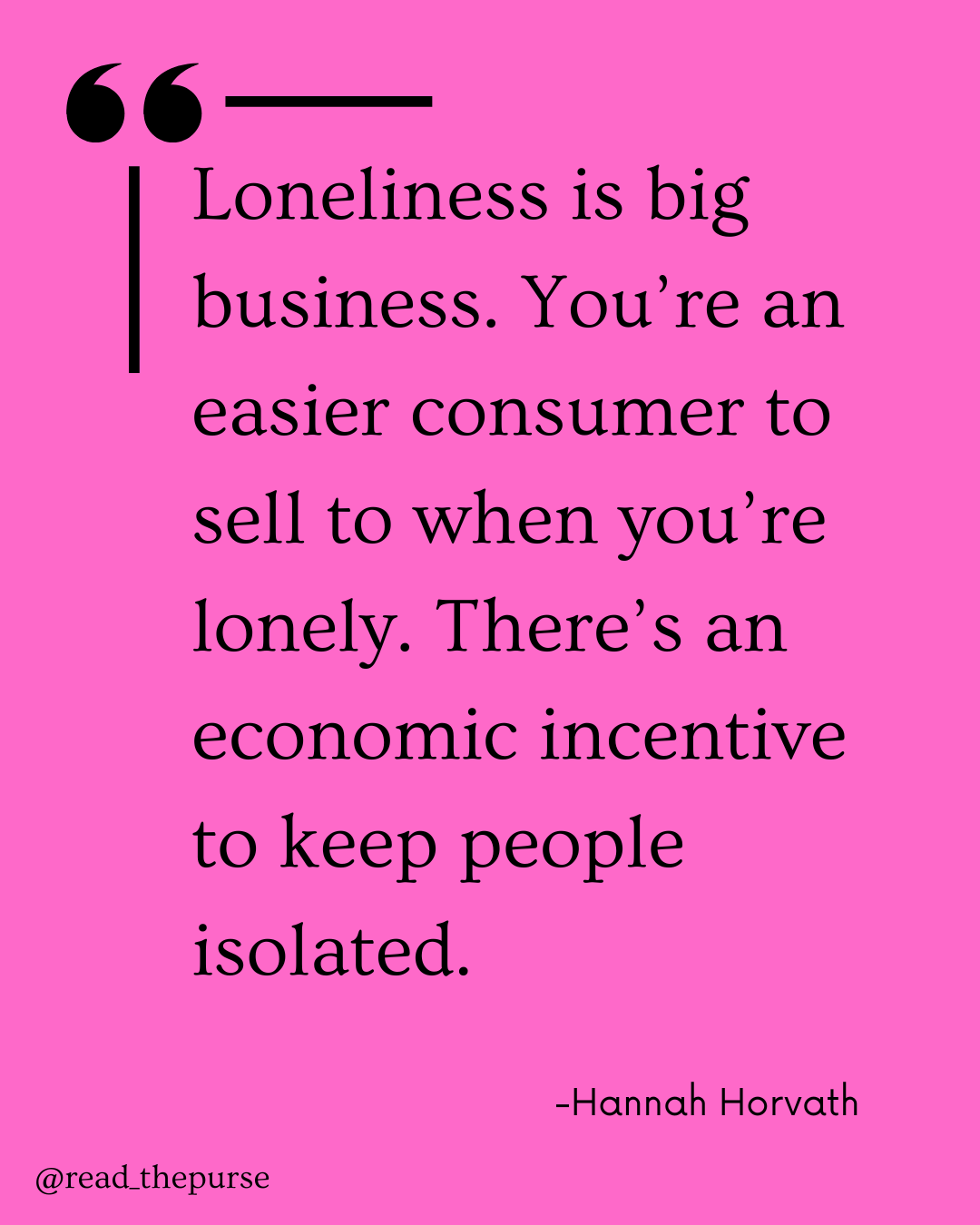
“It’s just so ripe for abuse,” says Hanna Horvath, a certified financial planner and financial journalist, who has written about prediction markets. Imagine a wealthy bad actor or group flooding a prediction market with bets on a certain political outcome to skew the results, with CNN reporting the compromised data live. Or even a journalist letting her own bets influence her coverage. It’s easy to see how that could be used to spread disinformation and solidify a narrative in a viewer’s mind.
The proliferation of legal sports betting and its seeming wholesale takeover of every aspect of professional and college sports in the U.S. is another example of financialization run amok. Now, you can’t simply watch a football game. Viewers are inundated—from the broadcast to the podcasters to, yes, the so-called journalists covering the game—with ads for sports gambling sites encouraging you to bet on everything from the final score to how many times Taylor Swift is featured during the broadcast.
Though some women make sports wagers, it is vastly more popular among young men, with polling indicating 48% of them have sports betting accounts.
“Sports betting specifically, I find especially nefarious, because it’s a social activity for a lot of people,” says Horvath. “[It] has become so unbelievably intertwined with the actual act of watching sports that you can’t even distinguish the two apart anymore.”
Legalized sports gambling has been linked to greater declines in credit scores, higher bankruptcy rates, and general financial distress, not to mention higher rates of domestic violence. On the collegiate level, players and students have reported being harassed by gamblers over lost bets, and conflicts and scandals abound. (The NCAA has taken out a TV spot asking bettors not to heckle players.)
Meanwhile, a 2024 study found that “problem behaviors” related to gambling are most prevalent among men aged 18 to 30. For all the handwringing over the state of boys and men vocalized by our leaders in recent months, they seem perfectly fine watching them gamble all of their money away. The tax revenue is just too tempting.
The appeal of prediction markets and sports gambling isn’t hard to discern. In an economy where it feels impossible to get ahead while working a normal 9-to-5 job, where bad actors making outrageous bets on cryptocurrency and meme stocks seem to be the only winners, why not gamble a few bucks here and there? But while many people may start out with one or two innocent bets, gambling can easily become an addiction, one that is exacerbated by ease of access. Like, say, being able to do it any time you want with a couple of taps on the computer in your pocket. “The country’s top pastime now doubles as a kind of dopamine-hit get-rich-quick scheme,” writes Molly Olmstead for Slate.
In our casino economy, seemingly every aspect of human life is being monetized. This is being billed as “innovation” by the finance set as they sit back and greedily count their stacks of cash, but it’s a disaster for the rest of us.
The house always wins, which is how all of these prediction markets and gambling sites can afford to advertise to you so aggressively and unceasingly in the first place. (If you do want to cash in on this degenerate gold rush, you can always apply to be the NFL’s sports betting director. If you can’t beat the house, join it.)
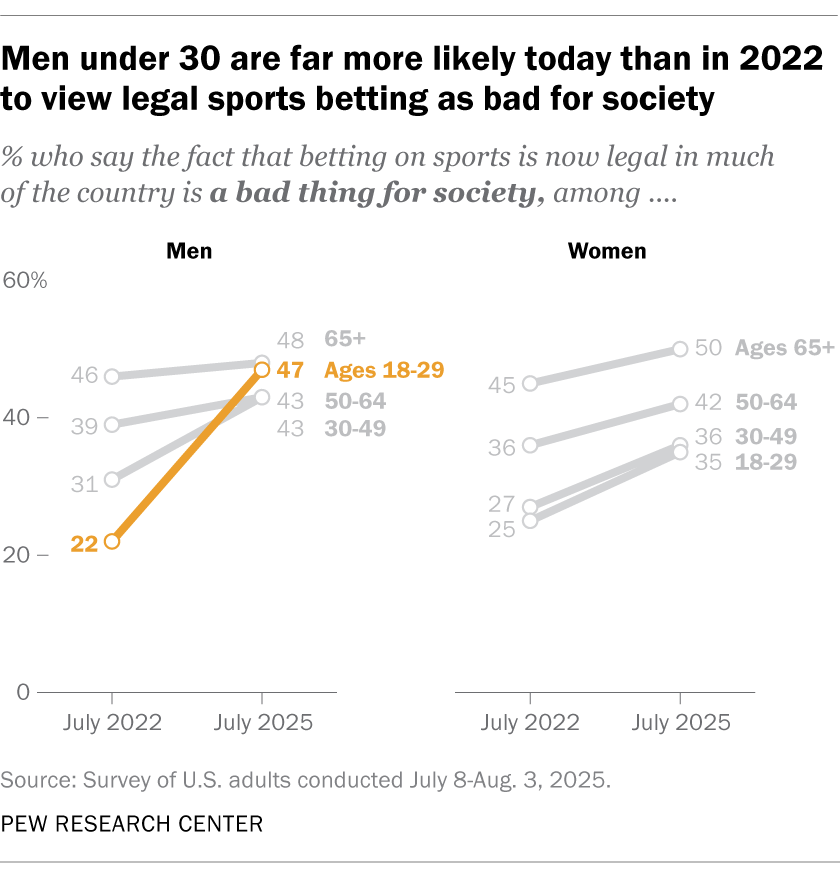
Some good news, from my vantage point, is that more people are starting to catch on, as this graph from the Pew Research Center shows. Particularly young men: 47% of men under 30 say legal sports betting is a bad thing for society, up from 22% who said the same thing in 2022.
I sincerely hope news media companies rethink their shameful partnerships, but I won’t hold my breath. In the casino economy, there’s no money in ethics.
-Alicia
Gambling and Prediction Markets in the News
- This 2023 Fresh Air interview with New York Times reporter Eric Lipton dives into how a 2018 Supreme Court ruling lifted the ban on sports betting, which ushered in this wild new era, and Bloomberg’s Emily Nicole has a helpful story on just how prediction markets work.
- Purse favorite Kyla Scanlon has an epic essay on the state of the economy, including a discussion of the issues around financialization. “When the labor market tightens and upward mobility stalls and when wealth is concentrated at the top and increasingly inaccessible, gambling feels like a rational response.”
- College campuses are at the fore of America’s sports-betting boom, The Economist reports. It’s taking a toll on young men: “Every one of [psychiatrist Timothy Fong’s] clients as of late has been an 18- to 24-year-old man seeking help for a sports-betting or cryptocurrency addiction.” Didn’t sports used to be, like, fun?
- The Cut recently published a depressing look at how sports gambling has affected four different women’s relationships with their partners and spouses. “Earlier this year he showed me the DraftKings app, which said he had spent $300,000 on bets over two years,” one said.
- Eric Lipton also wrote an exposé on how lobbyists have flooded state legislatures with money and other gifts in an effort to get sports gambling legalized. “They keep a special bottle for me up there—they know I like it,” said one Kansas lawmaker. “I’m in my element when I have a whiskey and a cigar.”
- I didn’t really get into how addictive these gambling apps can be, but Molly Olmstead’s piece in Slate is a sobering read. “Once you spend enough money, the companies assign real people to message you to send encouraging messages or offer deals,” she writes.
- Last month, Bank of America Securities warned that private lenders including Sallie Mae are under “pressure” because so many young people are losing money on sports gambling.
- And just yesterday, Kalshi and Crypto.com announced they’re launching a national alliance of prediction market operators that includes cryptocurrency exchange Coinbase, retail trading platform Robinhood, and sports gaming operator Underdog, Reuters reports.
- The Commodity Futures Trading Commission, which is supposed to regulate prediction markets, has cut staff by 15%, and four of its five commissioners resigned since Trump came into office. In recent years, federal courts have denied its attempts to restrict election betting.
What Else We’re Talking About
- Are we all drowning under year-end to-dos (on top of all the regular everyday to-dos)? Perhaps this is the holiday season to finally pay for the help you need. Faye pairs busy families with local, trusted Family Advisors who can help tackle holiday tasks like sending holiday cards and suggesting and purchasing last-minute gifts. Your dedicated Advisor handles all the details while Faye’s platform allows you to seamlessly (and securely) access all tasks, updates, and information. Each Advisor is U.S.-based, rigorously vetted, and trained for premium service, helping you save time and reclaim energy. Learn more on Faye’s website. #partner
- I love the way so many Hollywood stars have jumped to defend Paul Dano after Quentin Tarantino called him a “weak, uninteresting guy” in a recent podcast interview. Feels like it’s time for a re-watch of Little Miss Sunshine. -Lindsey
- I’m very behind on my reading goal for the year, but I recently finished The Bee Sting by Paul Murray and can’t stop thinking about it. The ending, to me, was perfect, which I’ve discovered is a controversial opinion. But it couldn’t have gone another way. I’m tempted to reread, though it is over 600 pages. -Alicia
- I was heartbroken to hear that novelist Sophie Kinsella died this week from a brain tumor at the too-young age of 55. Many people dismiss her writing as chick lit, but her Shopaholic series is brilliant: funny, clever, and so sweet. If you haven’t read them, I highly recommend. (They are also fantastic audio books!) It’s the perfect light reading for this time of year. -Lindsey
On Our Radar
I’ve been having so much fun with these Yahoo stories, and we have one more in 2025. I want to hear how you’re spending money on health and wellness. Fill out this form! -Lindsey
In this week’s Home Ec, we did a big callout for new submissions, including listing all the states we still haven’t featured. If you’re a Michiganer, make Alicia’s week and submit your story!
Quote of the Week
Best Money We Spent This Week
- As I wrote in Substack's subscriber chat, I spent $115 on my Christmas tree and stand! (We want to see more tree/holiday decor pics!) -Alicia
- I had a colonoscopy on Tuesday, and the prep was as miserable as advertised. But the Blue Bottle coffee ($6) I enjoyed after the procedure was one of the best cups of coffee I’ve had in a long time. -Lindsey


